Welcome to the Gichigamiin Indigenous Nations Museum Prairie Garden Virtual Map! Click anywhere on the garden below to learn more about the plant species featured
Gichigamiin Indigenous Nations Museum Prairie Garden

Heart Leaf Foamflower
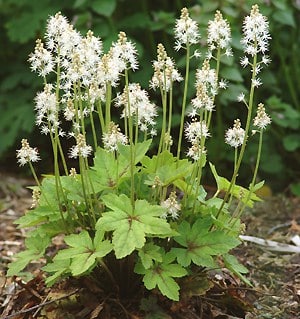
Latin Name: (Tiarella cordifolia)
Tiarella cordifolia, commonly called foamflower, is clump-forming perennial which spreads rapidly by runners (stolons) to form dense, 1-2' wide clumps of foliage. Plants are in the same family as and somewhat suggestive of Heuchera, Tellima and Mitella. Sometimes commonly called false miterwort because of its similarity to Mitella (miterwort). Semi-glossy, heart-shaped, 3-5 lobed leaves (4" across) rise directly from the stolons. Leaves may have reddish variegation along the veins. Foliage is evergreen in mild winters, often turning reddish bronze in autumn and winter. Tiny, white flowers with very long stamens (foamy texture of stamens results in the common name) appear in airy racemes in spring for about 6 weeks on numerous, erect, wiry, mostly leafless flower stems which rise well above the foliage clump to a height of 10-12". Flower buds are pinkish. (Source: Missouri Botanical Garden 'Plant Finder')
Pawpaw
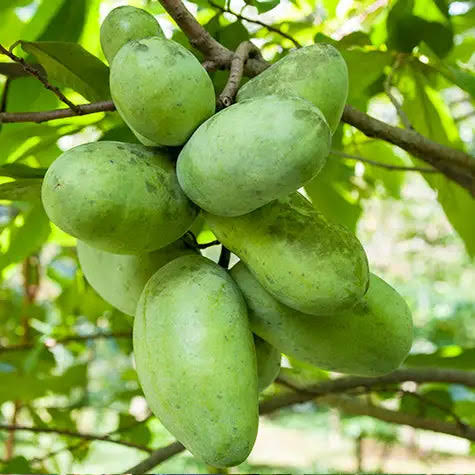
Latin Name: (Asimina triloba)
Ojibwe Name: Gozigwaakomin
Asimina triloba, commonly called pawpaw, is a Missouri native small understory tree or large shrub which typically grows 15-20' tall (sometimes to 30') and occurs in low bottom woods, wooded slopes, ravines and along streams. Often spreads by root suckers to form colonies or thickets. Large, slightly drooping, elliptical, medium green leaves (6-12" long) retain green color well into fall before turning to a bright (but sometimes undistinguished) yellow. Cup-shaped, purple flowers (3 green sepals and 6 purple petals in two tiers) appear in spring, and give way to edible, oblong, yellowish green fruits which mature in early autumn to a dark brown. Flavor and fleshy consistency of the sweet-flavored fruits resembles bananas. Fruits are frequently eaten raw or used in ice creams or pies, although they can produce nausea in some people. Wildlife (e.g., raccoons, squirrels and opossums) eagerly seek out the fruits and often beat humans to the harvest. Early Americans made a yellow dye from the pulp of the ripened fruit. (Source: Missouri Botanical Garden 'Plant Finder')
Serviceberry
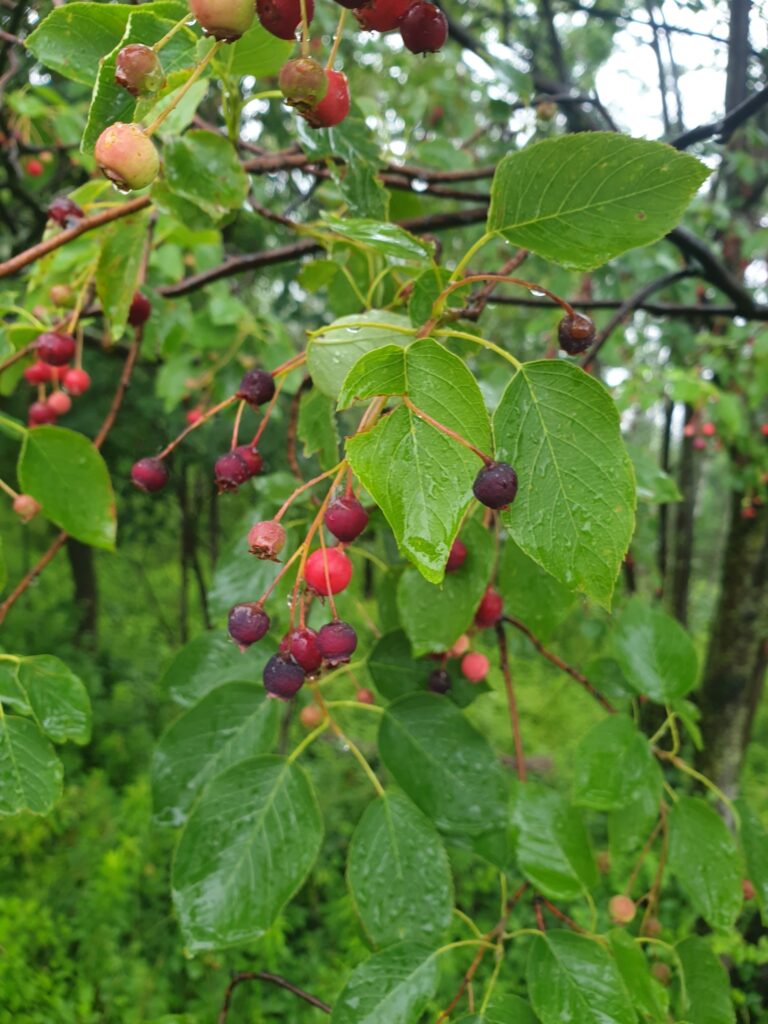
Latin Name: Amelanchier laevis
Menominee Name: Oskēh-nēpen mēn, "early summer blueberry" based on its appearance and that it comes a few months before blueberries
melanchier laevis, commomly called Allegheny serviceberry, is a small, deciduous, usually multi-trunked understory tree or tall shrub which is native to thickets, open woods, sheltered slopes and wood margins in Eastern North America where it typically grows 15-25' (less frequently to 40') tall. Features showy, 5-petaled, slightly fragrant, white flowers in drooping clusters which appear in early spring (April) before the leaves. Flowers give way to small, round, edible berries which ripen to dark purplish-black in June (hence the sometimes common name of Juneberry) and resemble blueberries in size, color and taste. Berries are often used in jams, jellies and pies. Finely-toothed, obovate leaves emerge with a bronzish-purple tinge in spring, mature to lustrous dark green in summer and turn red-orange in fall. This tree is primarily distinguished from the very similar Missouri native downy serviceberry (A. arborea) by its hairless foliage, purplish-tinged new growth and tastier (sweeter and juicier) berries. (Source: Missouri Botanical Garden 'Plant Finder')
Pawpaw
Latin Name: (Asimina triloba)
Ojibwe Name: Gozigwaakomin
Asimina triloba, commonly called pawpaw, is a Missouri native small understory tree or large shrub which typically grows 15-20' tall (sometimes to 30') and occurs in low bottom woods, wooded slopes, ravines and along streams. Often spreads by root suckers to form colonies or thickets. Large, slightly drooping, elliptical, medium green leaves (6-12" long) retain green color well into fall before turning to a bright (but sometimes undistinguished) yellow. Cup-shaped, purple flowers (3 green sepals and 6 purple petals in two tiers) appear in spring, and give way to edible, oblong, yellowish green fruits which mature in early autumn to a dark brown. Flavor and fleshy consistency of the sweet-flavored fruits resembles bananas. Fruits are frequently eaten raw or used in ice creams or pies, although they can produce nausea in some people. Wildlife (e.g., raccoons, squirrels and opossums) eagerly seek out the fruits and often beat humans to the harvest. Early Americans made a yellow dye from the pulp of the ripened fruit. (Source: Missouri Botanical Garden 'Plant Finder')
Cinnamon Fern
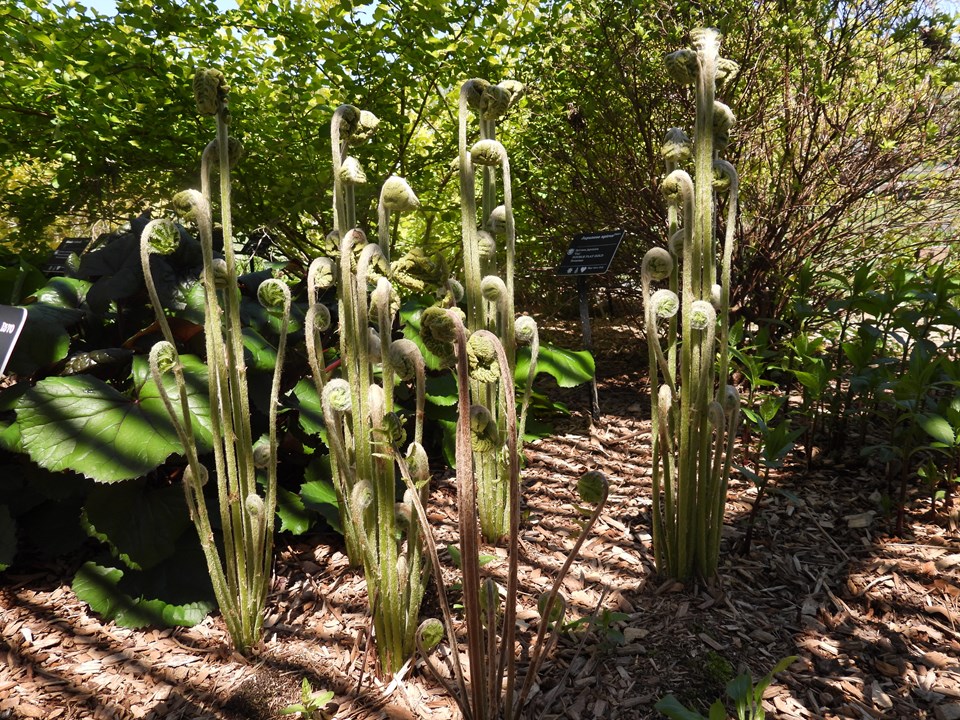
Latin Name: Osmundastrum cinnamomeum
Menominee Name:Nōnākanawas
This is a perennial fern with ovate, lance-shaped, sterile fronds 2 to 5 feet tall with pinnate segments surrounding much narrower erect fertile fronds. The top of each fertile frond is a mass of cinnamon-brown sporangia (equivalent to seeds in more developed plants) from which it takes its name. It grows in moist, fertile soil, along ponds where it can make a striking focal point, or in backgrounds of perennial beds as long as they are kept damp. It is hardy in USDA Zone 4. (Source: Chicago Botanic Garden)
Wild Leek
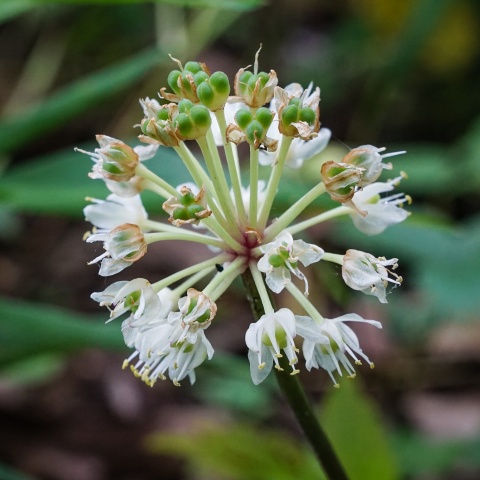
Latin Name: Allium tricoccum
Menominee Name: Pekuac-sekākūhsyah, translates to "wild skunk plant" due to its strong smell.
This is the plant for which Chicago is named. In Illinois Indian language, its name was Chicagoua. This name probably was applied as a metaphor for the skunk-like odor of the leaves when crushed by walking on them. Chicagoua basically means skunk, from the spraying of defensive liquid. Contrary to popular belief, it does not mean offensive odor, which would be matchi miaganoue. This information appears in 17th-century Jesuit linguistic manuscripts.
The leaves emerge in April, and then the plant is edible; but when flowers emerge, the flavor turns very pungent, and most people would deem it inedible. If eaten at this flowering stage or later in its life cycle, it produces a highly odorific breath which must be experienced to be believed. (Source: Chicago Botanic Garden)
Pennsylvania Sedge
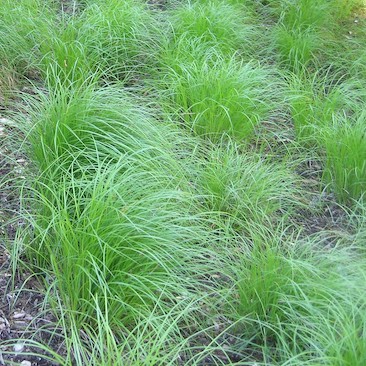
Latin Name: Carex pensylvanica
Menominee Name: Kenūpikwas, translates to "snake grass", which is the general name for sedges
This perennial grows to a height of 1 foot with partial shade to full shade and dry to moderate moisture conditions. Native to the Midwest, it belongs in a border or can be used as a ground cover. (Source: Chicago Botanic Garden)
Pennsylvania Sedge
Latin Name: Carex pensylvanica
Menominee Name: Kenūpikwas, translates to "snake grass", which is the general name for sedges
This perennial grows to a height of 1 foot with partial shade to full shade and dry to moderate moisture conditions. Native to the Midwest, it belongs in a border or can be used as a ground cover. (Source: Chicago Botanic Garden)
Rosy Sedge
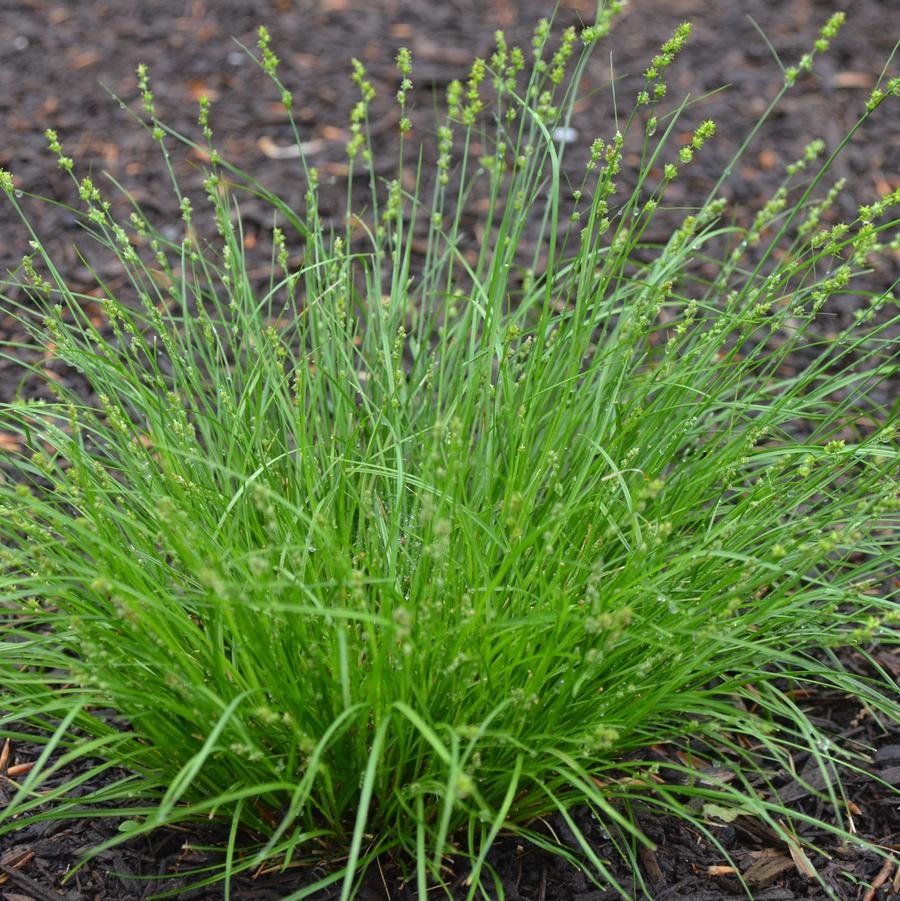
Latin Name: Carex radiata
Menominee Name: Kenūpikwas, translates to "snake grass", which is the general name for sedges
Carex rosea is a native North American woodland sedge that forms low-growing, spreading mats. Growing 6-12 inches tall, this species features narrow, bright green leaf blades and delicate, rosy-pink flower/fruit spikes.
Rosy Sedge prefers consistently moist, well-drained soils in partial shade to full shade conditions. It is naturally found in rich, deciduous forests and other shaded, humid habitats.
In the landscape, Carex rosea makes an excellent groundcover or accent plant for woodland gardens and shaded borders. Its mat-forming habit allows it to effectively cover the ground and suppress weeds. Rosy Sedge also provides visual interest with its unique inflorescences. With minimal maintenance required, it is an adaptable and resilient native sedge. (Source: North Shore Plant Club)
White Tinged Sedge
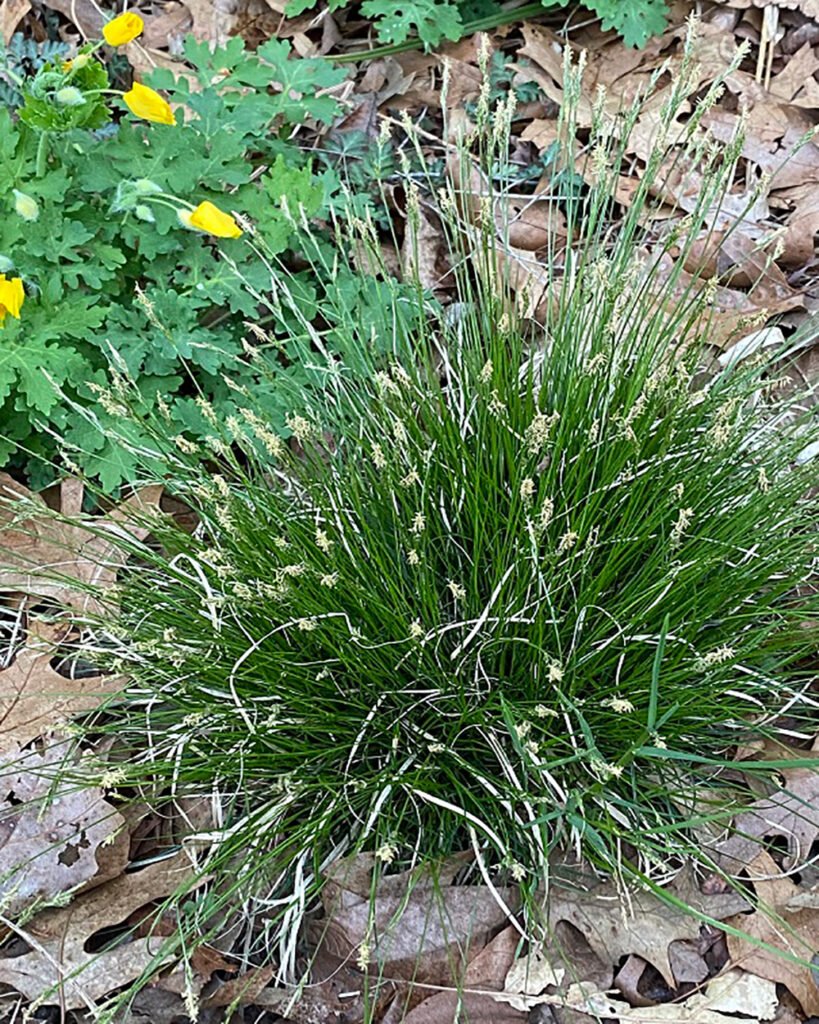
Latin Name: Carex albicans
Menominee Name: Kenūpikwas, translates to "snake grass", which is the general name for sedges
Narrow, grass-like, upright-arching bright green leaf blades grow in dense tufts or loose colonies of tufts. Blooms in late spring (May) on flowering stems as tall as twenty inches. Native to North America from Quebec and Ontario south to Florida and Texas. (Source: North Shore Plant Club)
Pennsylvania Sedge
Latin Name: Carex pensylvanica
Menominee Name: Kenūpikwas, translates to "snake grass", which is the general name for sedges
This perennial grows to a height of 1 foot with partial shade to full shade and dry to moderate moisture conditions. Native to the Midwest, it belongs in a border or can be used as a ground cover. (Source: Chicago Botanic Garden)
White Tinged Sedge
Latin Name: Carex albicans
Menominee Name: Kenūpikwas, translates to "snake grass", which is the general name for sedges
Narrow, grass-like, upright-arching bright green leaf blades grow in dense tufts or loose colonies of tufts. Blooms in late spring (May) on flowering stems as tall as twenty inches. Native to North America from Quebec and Ontario south to Florida and Texas. (Source: North Shore Plant Club)
Pennsylvania Sedge
Latin Name: Carex pensylvanica
Menominee Name: Kenūpikwas, translates to "snake grass", which is the general name for sedges
This perennial grows to a height of 1 foot with partial shade to full shade and dry to moderate moisture conditions. Native to the Midwest, it belongs in a border or can be used as a ground cover. (Source: Chicago Botanic Garden)
Rosy Sedge
Latin Name: Carex radiata
Menominee Name: Kenūpikwas, translates to "snake grass", which is the general name for sedges
Carex rosea is a native North American woodland sedge that forms low-growing, spreading mats. Growing 6-12 inches tall, this species features narrow, bright green leaf blades and delicate, rosy-pink flower/fruit spikes.
Rosy Sedge prefers consistently moist, well-drained soils in partial shade to full shade conditions. It is naturally found in rich, deciduous forests and other shaded, humid habitats.
In the landscape, Carex rosea makes an excellent groundcover or accent plant for woodland gardens and shaded borders. Its mat-forming habit allows it to effectively cover the ground and suppress weeds. Rosy Sedge also provides visual interest with its unique inflorescences. With minimal maintenance required, it is an adaptable and resilient native sedge. (Source: North Shore Plant Club)
White Tinged Sedge
Latin Name: Carex albicans
Menominee Name: Kenūpikwas, translates to "snake grass", which is the general name for sedges
Narrow, grass-like, upright-arching bright green leaf blades grow in dense tufts or loose colonies of tufts. Blooms in late spring (May) on flowering stems as tall as twenty inches. Native to North America from Quebec and Ontario south to Florida and Texas. (Source: North Shore Plant Club)
Pennsylvania Sedge
Latin Name: Carex pensylvanica
Menominee Name: Kenūpikwas, translates to "snake grass", which is the general name for sedges
This perennial grows to a height of 1 foot with partial shade to full shade and dry to moderate moisture conditions. Native to the Midwest, it belongs in a border or can be used as a ground cover. (Source: Chicago Botanic Garden)
Prairie Dropseed

Latin Name: Sporobolus heterolepis
Menominee Name: Asēkanan, general name for grasses
Sporobolus heterolepis, called prairie dropseed, is a clump-forming, warm season, perennial grass which typically occurs in prairies, glades, open ground and along railroads in parts of the central and western United States and southern Canada. Fine-textured, hair-like, medium green leaves (to 20” long and 1/16” wide) typically form an arching foliage mound to 15” tall and 18” wide. Foliage turns golden with orange hues in fall, fading to light bronze in winter. Open, branching flower panicles appear on slender stems which rise well above the foliage clump in late summer to 30-36" tall. Flowers have pink and brown coloration but are perhaps most noted for their unique and noticeable (some may say pungent) scent that has variously been described as resembling a combination of coriander, popcorn, honey, sunflower seeds, and melted wax. Tiny rounded mature seeds drop to the ground from their hulls in autumn giving rise to the descriptive common name. (Source: Missouri Botanic Garden Plant Finder)
June Grass

Latin Name: Koeleria macrantha
Menominee Name: Atāēhemen-kēsōq asēkanan, "Strawberry Moon Grass", as it blooms in June when the Strawmberry Moon is out.
Koeleria macrantha, commonly called prairie junegrass, is a cool season, clump-forming, tufted, perennial bunch grass that is native throughout most of the contiguous U.S. except for the Southeast and parts of the Northeast. It is also found in Europe and Asia. In Illinois, it is typically found in dry prairies and open woods in the southwestern and central parts of the state (Steyermark). It typically grows in a compact, erect clump to 2’ tall. Mostly basal leaves (to 7” long) are medium to bright green, but may be tinged with gray-green. Narrow tapered inflorescences (to 5” long) appear in late spring atop flower spikes rising well above the basal foliage. Inflorescences open light green but change to silver-green as the seed heads mature. (Source: Missouri Botanic Garden Plant Finder)
Prairie Dropseed
Latin Name: Sporobolus heterolepis
Menominee Name: Asēkanan, general name for grasses
Sporobolus heterolepis, called prairie dropseed, is a clump-forming, warm season, perennial grass which typically occurs in prairies, glades, open ground and along railroads in parts of the central and western United States and southern Canada. Fine-textured, hair-like, medium green leaves (to 20” long and 1/16” wide) typically form an arching foliage mound to 15” tall and 18” wide. Foliage turns golden with orange hues in fall, fading to light bronze in winter. Open, branching flower panicles appear on slender stems which rise well above the foliage clump in late summer to 30-36" tall. Flowers have pink and brown coloration but are perhaps most noted for their unique and noticeable (some may say pungent) scent that has variously been described as resembling a combination of coriander, popcorn, honey, sunflower seeds, and melted wax. Tiny rounded mature seeds drop to the ground from their hulls in autumn giving rise to the descriptive common name. (Source: Missouri Botanic Garden Plant Finder)
Little Bluestem

Latin Name: Schizachyrium scoparium
Menominee Name: Asēkanan, general name for grasses
A true native of the tallgrass prairie, this rugged, warm-season grass grows throughout the eastern and central states, in prairie remnants, dry hills, and open woods. Its cold and drought tolerance, along with its ornamental attributes, make it a good choice for naturalistic or more formal plantings, massed in hilly drifts, aiding in erosion control as a ground cover, or highlighting mixed borders. The Chicagoland Grows® Plant Introduction Program has recently introduced 'Carousel', a compact selection of little bluestem that features outstanding ornamental traits year-round.
Little bluestem prefers full sun but is not fussy about soil as long as it is not too rich or wet. In spring, just as the narcissus emerge, cut the dried clump back to a few inches. This grass is a good companion to bulbs since both prefer dry summer conditions. Later in the season, little bluestem looks especially fine when paired with sedums, goldenrods, asters, and other favorite late bloomers.
Some have referred to little bluestem as "neither little nor blue." In the Chicago area it grows close to 3 feet, with most of that height taken by the stems that remain erect even in winter, and the seedheads that provide food for hungry birds. But it is the constantly changing color of this grass that is so impressive. Emerging pale gray green in spring, the stems and foliage darken throughout summer but retain a hint of blue at their base. Other gardeners report a deepening blue, almost into purple, as summer progresses. Silvery flower stalks appear July to September. Autumn brings out the reds, as dipping temperatures increase the flame to brilliant orange. Winter color can remain coppery brown, so lovely when set against evergreens in the snow. Because of the considerable color variance of this grass, delightful surprises are in store for the gardener! Little bluestem, and other wonders of the winter landscape, can be found in the Prairie, the parking areas, the Native Plant Garden, the Landscape Gardens, and the Heritage Garden. (Source: Chicago Botanical Garden)
Blue Grama Grass

Latin Name: Bouteloua gracilis
This perennial grows to a height of 2 feet with full sun to partial shade and moderate moisture conditions. It has showy reddish-purple blooms from June to August and belongs in a border. It is also attractive to birds. (Source: Chicago Botanical Garden)
Prairie Dropseed
Latin Name: Sporobolus heterolepis
Menominee Name: Asēkanan, general name for grasses
Sporobolus heterolepis, called prairie dropseed, is a clump-forming, warm season, perennial grass which typically occurs in prairies, glades, open ground and along railroads in parts of the central and western United States and southern Canada. Fine-textured, hair-like, medium green leaves (to 20” long and 1/16” wide) typically form an arching foliage mound to 15” tall and 18” wide. Foliage turns golden with orange hues in fall, fading to light bronze in winter. Open, branching flower panicles appear on slender stems which rise well above the foliage clump in late summer to 30-36" tall. Flowers have pink and brown coloration but are perhaps most noted for their unique and noticeable (some may say pungent) scent that has variously been described as resembling a combination of coriander, popcorn, honey, sunflower seeds, and melted wax. Tiny rounded mature seeds drop to the ground from their hulls in autumn giving rise to the descriptive common name. (Source: Missouri Botanic Garden Plant Finder)
Prairie Dropseed
Latin Name: Sporobolus heterolepis
Menominee Name: Asēkanan, general name for grasses
Sporobolus heterolepis, called prairie dropseed, is a clump-forming, warm season, perennial grass which typically occurs in prairies, glades, open ground and along railroads in parts of the central and western United States and southern Canada. Fine-textured, hair-like, medium green leaves (to 20” long and 1/16” wide) typically form an arching foliage mound to 15” tall and 18” wide. Foliage turns golden with orange hues in fall, fading to light bronze in winter. Open, branching flower panicles appear on slender stems which rise well above the foliage clump in late summer to 30-36" tall. Flowers have pink and brown coloration but are perhaps most noted for their unique and noticeable (some may say pungent) scent that has variously been described as resembling a combination of coriander, popcorn, honey, sunflower seeds, and melted wax. Tiny rounded mature seeds drop to the ground from their hulls in autumn giving rise to the descriptive common name. (Source: Missouri Botanic Garden Plant Finder)
Blue Grama Grass
Latin Name: Bouteloua gracilis
This perennial grows to a height of 2 feet with full sun to partial shade and moderate moisture conditions. It has showy reddish-purple blooms from June to August and belongs in a border. It is also attractive to birds. (Source: Chicago Botanical Garden)
Prairie Dropseed
Latin Name: Sporobolus heterolepis
Menominee Name: Asēkanan, general name for grasses
Sporobolus heterolepis, called prairie dropseed, is a clump-forming, warm season, perennial grass which typically occurs in prairies, glades, open ground and along railroads in parts of the central and western United States and southern Canada. Fine-textured, hair-like, medium green leaves (to 20” long and 1/16” wide) typically form an arching foliage mound to 15” tall and 18” wide. Foliage turns golden with orange hues in fall, fading to light bronze in winter. Open, branching flower panicles appear on slender stems which rise well above the foliage clump in late summer to 30-36" tall. Flowers have pink and brown coloration but are perhaps most noted for their unique and noticeable (some may say pungent) scent that has variously been described as resembling a combination of coriander, popcorn, honey, sunflower seeds, and melted wax. Tiny rounded mature seeds drop to the ground from their hulls in autumn giving rise to the descriptive common name. (Source: Missouri Botanic Garden Plant Finder)
Little Bluestem
Latin Name: Schizachyrium scoparium
Menominee Name: Asēkanan, general name for grasses
A true native of the tallgrass prairie, this rugged, warm-season grass grows throughout the eastern and central states, in prairie remnants, dry hills, and open woods. Its cold and drought tolerance, along with its ornamental attributes, make it a good choice for naturalistic or more formal plantings, massed in hilly drifts, aiding in erosion control as a ground cover, or highlighting mixed borders. The Chicagoland Grows® Plant Introduction Program has recently introduced 'Carousel', a compact selection of little bluestem that features outstanding ornamental traits year-round.
Little bluestem prefers full sun but is not fussy about soil as long as it is not too rich or wet. In spring, just as the narcissus emerge, cut the dried clump back to a few inches. This grass is a good companion to bulbs since both prefer dry summer conditions. Later in the season, little bluestem looks especially fine when paired with sedums, goldenrods, asters, and other favorite late bloomers.
Some have referred to little bluestem as "neither little nor blue." In the Chicago area it grows close to 3 feet, with most of that height taken by the stems that remain erect even in winter, and the seedheads that provide food for hungry birds. But it is the constantly changing color of this grass that is so impressive. Emerging pale gray green in spring, the stems and foliage darken throughout summer but retain a hint of blue at their base. Other gardeners report a deepening blue, almost into purple, as summer progresses. Silvery flower stalks appear July to September. Autumn brings out the reds, as dipping temperatures increase the flame to brilliant orange. Winter color can remain coppery brown, so lovely when set against evergreens in the snow. Because of the considerable color variance of this grass, delightful surprises are in store for the gardener! Little bluestem, and other wonders of the winter landscape, can be found in the Prairie, the parking areas, the Native Plant Garden, the Landscape Gardens, and the Heritage Garden. (Source: Chicago Botanical Garden)
Blue Grama Grass
Latin Name: Bouteloua gracilis
This perennial grows to a height of 2 feet with full sun to partial shade and moderate moisture conditions. It has showy reddish-purple blooms from June to August and belongs in a border. It is also attractive to birds. (Source: Chicago Botanical Garden)
June Grass
Latin Name: Koeleria macrantha
Menominee Name: Atāēhemen-kēsōq asēkanan, "Strawberry Moon Grass", as it blooms in June when the Strawmberry Moon is out.
Koeleria macrantha, commonly called prairie junegrass, is a cool season, clump-forming, tufted, perennial bunch grass that is native throughout most of the contiguous U.S. except for the Southeast and parts of the Northeast. It is also found in Europe and Asia. In Illinois, it is typically found in dry prairies and open woods in the southwestern and central parts of the state (Steyermark). It typically grows in a compact, erect clump to 2’ tall. Mostly basal leaves (to 7” long) are medium to bright green, but may be tinged with gray-green. Narrow tapered inflorescences (to 5” long) appear in late spring atop flower spikes rising well above the basal foliage. Inflorescences open light green but change to silver-green as the seed heads mature. (Source: Missouri Botanic Garden Plant Finder)
Little Bluestem
Latin Name: Schizachyrium scoparium
Menominee Name: Asēkanan, general name for grasses
A true native of the tallgrass prairie, this rugged, warm-season grass grows throughout the eastern and central states, in prairie remnants, dry hills, and open woods. Its cold and drought tolerance, along with its ornamental attributes, make it a good choice for naturalistic or more formal plantings, massed in hilly drifts, aiding in erosion control as a ground cover, or highlighting mixed borders. The Chicagoland Grows® Plant Introduction Program has recently introduced 'Carousel', a compact selection of little bluestem that features outstanding ornamental traits year-round.
Little bluestem prefers full sun but is not fussy about soil as long as it is not too rich or wet. In spring, just as the narcissus emerge, cut the dried clump back to a few inches. This grass is a good companion to bulbs since both prefer dry summer conditions. Later in the season, little bluestem looks especially fine when paired with sedums, goldenrods, asters, and other favorite late bloomers.
Some have referred to little bluestem as "neither little nor blue." In the Chicago area it grows close to 3 feet, with most of that height taken by the stems that remain erect even in winter, and the seedheads that provide food for hungry birds. But it is the constantly changing color of this grass that is so impressive. Emerging pale gray green in spring, the stems and foliage darken throughout summer but retain a hint of blue at their base. Other gardeners report a deepening blue, almost into purple, as summer progresses. Silvery flower stalks appear July to September. Autumn brings out the reds, as dipping temperatures increase the flame to brilliant orange. Winter color can remain coppery brown, so lovely when set against evergreens in the snow. Because of the considerable color variance of this grass, delightful surprises are in store for the gardener! Little bluestem, and other wonders of the winter landscape, can be found in the Prairie, the parking areas, the Native Plant Garden, the Landscape Gardens, and the Heritage Garden. (Source: Chicago Botanical Garden)
Prairie Dropseed
Latin Name: Sporobolus heterolepis
Menominee Name: Asēkanan, general name for grasses
Sporobolus heterolepis, called prairie dropseed, is a clump-forming, warm season, perennial grass which typically occurs in prairies, glades, open ground and along railroads in parts of the central and western United States and southern Canada. Fine-textured, hair-like, medium green leaves (to 20” long and 1/16” wide) typically form an arching foliage mound to 15” tall and 18” wide. Foliage turns golden with orange hues in fall, fading to light bronze in winter. Open, branching flower panicles appear on slender stems which rise well above the foliage clump in late summer to 30-36" tall. Flowers have pink and brown coloration but are perhaps most noted for their unique and noticeable (some may say pungent) scent that has variously been described as resembling a combination of coriander, popcorn, honey, sunflower seeds, and melted wax. Tiny rounded mature seeds drop to the ground from their hulls in autumn giving rise to the descriptive common name. (Source: Missouri Botanic Garden Plant Finder)
Prairie Dropseed
Latin Name: Sporobolus heterolepis
Menominee Name: Asēkanan, general name for grasses
Sporobolus heterolepis, called prairie dropseed, is a clump-forming, warm season, perennial grass which typically occurs in prairies, glades, open ground and along railroads in parts of the central and western United States and southern Canada. Fine-textured, hair-like, medium green leaves (to 20” long and 1/16” wide) typically form an arching foliage mound to 15” tall and 18” wide. Foliage turns golden with orange hues in fall, fading to light bronze in winter. Open, branching flower panicles appear on slender stems which rise well above the foliage clump in late summer to 30-36" tall. Flowers have pink and brown coloration but are perhaps most noted for their unique and noticeable (some may say pungent) scent that has variously been described as resembling a combination of coriander, popcorn, honey, sunflower seeds, and melted wax. Tiny rounded mature seeds drop to the ground from their hulls in autumn giving rise to the descriptive common name. (Source: Missouri Botanic Garden Plant Finder)
Prairie Dropseed
Latin Name: Sporobolus heterolepis
Menominee Name: Asēkanan, general name for grasses
Sporobolus heterolepis, called prairie dropseed, is a clump-forming, warm season, perennial grass which typically occurs in prairies, glades, open ground and along railroads in parts of the central and western United States and southern Canada. Fine-textured, hair-like, medium green leaves (to 20” long and 1/16” wide) typically form an arching foliage mound to 15” tall and 18” wide. Foliage turns golden with orange hues in fall, fading to light bronze in winter. Open, branching flower panicles appear on slender stems which rise well above the foliage clump in late summer to 30-36" tall. Flowers have pink and brown coloration but are perhaps most noted for their unique and noticeable (some may say pungent) scent that has variously been described as resembling a combination of coriander, popcorn, honey, sunflower seeds, and melted wax. Tiny rounded mature seeds drop to the ground from their hulls in autumn giving rise to the descriptive common name. (Source: Missouri Botanic Garden Plant Finder)
Little Bluestem
Latin Name: Schizachyrium scoparium
Menominee Name: Asēkanan, general name for grasses
A true native of the tallgrass prairie, this rugged, warm-season grass grows throughout the eastern and central states, in prairie remnants, dry hills, and open woods. Its cold and drought tolerance, along with its ornamental attributes, make it a good choice for naturalistic or more formal plantings, massed in hilly drifts, aiding in erosion control as a ground cover, or highlighting mixed borders. The Chicagoland Grows® Plant Introduction Program has recently introduced 'Carousel', a compact selection of little bluestem that features outstanding ornamental traits year-round.
Little bluestem prefers full sun but is not fussy about soil as long as it is not too rich or wet. In spring, just as the narcissus emerge, cut the dried clump back to a few inches. This grass is a good companion to bulbs since both prefer dry summer conditions. Later in the season, little bluestem looks especially fine when paired with sedums, goldenrods, asters, and other favorite late bloomers.
Some have referred to little bluestem as "neither little nor blue." In the Chicago area it grows close to 3 feet, with most of that height taken by the stems that remain erect even in winter, and the seedheads that provide food for hungry birds. But it is the constantly changing color of this grass that is so impressive. Emerging pale gray green in spring, the stems and foliage darken throughout summer but retain a hint of blue at their base. Other gardeners report a deepening blue, almost into purple, as summer progresses. Silvery flower stalks appear July to September. Autumn brings out the reds, as dipping temperatures increase the flame to brilliant orange. Winter color can remain coppery brown, so lovely when set against evergreens in the snow. Because of the considerable color variance of this grass, delightful surprises are in store for the gardener! Little bluestem, and other wonders of the winter landscape, can be found in the Prairie, the parking areas, the Native Plant Garden, the Landscape Gardens, and the Heritage Garden. (Source: Chicago Botanical Garden)
Blue Grama Grass
Latin Name: Bouteloua gracilis
This perennial grows to a height of 2 feet with full sun to partial shade and moderate moisture conditions. It has showy reddish-purple blooms from June to August and belongs in a border. It is also attractive to birds. (Source: Chicago Botanical Garden)
Pennsylvania Sedge
Latin Name: Carex pensylvanica
Menominee Name: Kenūpikwas, translates to "snake grass", which is the general name for sedges
This perennial grows to a height of 1 foot with partial shade to full shade and dry to moderate moisture conditions. Native to the Midwest, it belongs in a border or can be used as a ground cover. (Source: Chicago Botanic Garden)
White Tinged Sedge
Latin Name: Carex albicans
Menominee Name: Kenūpikwas, translates to "snake grass", which is the general name for sedges
Narrow, grass-like, upright-arching bright green leaf blades grow in dense tufts or loose colonies of tufts. Blooms in late spring (May) on flowering stems as tall as twenty inches. Native to North America from Quebec and Ontario south to Florida and Texas. (Source: North Shore Plant Club)
Pennsylvania Sedge
Latin Name: Carex pensylvanica
Menominee Name: Kenūpikwas, translates to "snake grass", which is the general name for sedges
This perennial grows to a height of 1 foot with partial shade to full shade and dry to moderate moisture conditions. Native to the Midwest, it belongs in a border or can be used as a ground cover. (Source: Chicago Botanic Garden)
Rosy Sedge
Latin Name: Carex radiata
Menominee Name: Kenūpikwas, translates to "snake grass", which is the general name for sedges
Carex rosea is a native North American woodland sedge that forms low-growing, spreading mats. Growing 6-12 inches tall, this species features narrow, bright green leaf blades and delicate, rosy-pink flower/fruit spikes.
Rosy Sedge prefers consistently moist, well-drained soils in partial shade to full shade conditions. It is naturally found in rich, deciduous forests and other shaded, humid habitats.
In the landscape, Carex rosea makes an excellent groundcover or accent plant for woodland gardens and shaded borders. Its mat-forming habit allows it to effectively cover the ground and suppress weeds. Rosy Sedge also provides visual interest with its unique inflorescences. With minimal maintenance required, it is an adaptable and resilient native sedge. (Source: North Shore Plant Club)
White Tinged Sedge
Latin Name: Carex albicans
Menominee Name: Kenūpikwas, translates to "snake grass", which is the general name for sedges
Narrow, grass-like, upright-arching bright green leaf blades grow in dense tufts or loose colonies of tufts. Blooms in late spring (May) on flowering stems as tall as twenty inches. Native to North America from Quebec and Ontario south to Florida and Texas. (Source: North Shore Plant Club)
Rosy Sedge
Latin Name: Carex radiata
Menominee Name: Kenūpikwas, translates to "snake grass", which is the general name for sedges
Carex rosea is a native North American woodland sedge that forms low-growing, spreading mats. Growing 6-12 inches tall, this species features narrow, bright green leaf blades and delicate, rosy-pink flower/fruit spikes.
Rosy Sedge prefers consistently moist, well-drained soils in partial shade to full shade conditions. It is naturally found in rich, deciduous forests and other shaded, humid habitats.
In the landscape, Carex rosea makes an excellent groundcover or accent plant for woodland gardens and shaded borders. Its mat-forming habit allows it to effectively cover the ground and suppress weeds. Rosy Sedge also provides visual interest with its unique inflorescences. With minimal maintenance required, it is an adaptable and resilient native sedge. (Source: North Shore Plant Club)
White Tinged Sedge
Latin Name: Carex albicans
Menominee Name: Kenūpikwas, translates to "snake grass", which is the general name for sedges
Narrow, grass-like, upright-arching bright green leaf blades grow in dense tufts or loose colonies of tufts. Blooms in late spring (May) on flowering stems as tall as twenty inches. Native to North America from Quebec and Ontario south to Florida and Texas. (Source: North Shore Plant Club)
Prairie Dropseed
Latin Name: Sporobolus heterolepis
Menominee Name: Asēkanan, general name for grasses
Sporobolus heterolepis, called prairie dropseed, is a clump-forming, warm season, perennial grass which typically occurs in prairies, glades, open ground and along railroads in parts of the central and western United States and southern Canada. Fine-textured, hair-like, medium green leaves (to 20” long and 1/16” wide) typically form an arching foliage mound to 15” tall and 18” wide. Foliage turns golden with orange hues in fall, fading to light bronze in winter. Open, branching flower panicles appear on slender stems which rise well above the foliage clump in late summer to 30-36" tall. Flowers have pink and brown coloration but are perhaps most noted for their unique and noticeable (some may say pungent) scent that has variously been described as resembling a combination of coriander, popcorn, honey, sunflower seeds, and melted wax. Tiny rounded mature seeds drop to the ground from their hulls in autumn giving rise to the descriptive common name. (Source: Missouri Botanic Garden Plant Finder)
Pennsylvania Sedge
Latin Name: Carex pensylvanica
Menominee Name: Kenūpikwas, translates to "snake grass", which is the general name for sedges
This perennial grows to a height of 1 foot with partial shade to full shade and dry to moderate moisture conditions. Native to the Midwest, it belongs in a border or can be used as a ground cover. (Source: Chicago Botanic Garden)
Pennsylvania Sedge
Latin Name: Carex pensylvanica
Menominee Name: Kenūpikwas, translates to "snake grass", which is the general name for sedges
This perennial grows to a height of 1 foot with partial shade to full shade and dry to moderate moisture conditions. Native to the Midwest, it belongs in a border or can be used as a ground cover. (Source: Chicago Botanic Garden)
White Tinged Sedge
Latin Name: Carex albicans
Menominee Name: Kenūpikwas, translates to "snake grass", which is the general name for sedges
Narrow, grass-like, upright-arching bright green leaf blades grow in dense tufts or loose colonies of tufts. Blooms in late spring (May) on flowering stems as tall as twenty inches. Native to North America from Quebec and Ontario south to Florida and Texas. (Source: North Shore Plant Club)
Pennsylvania Sedge
Latin Name: Carex pensylvanica
Menominee Name: Kenūpikwas, translates to "snake grass", which is the general name for sedges
This perennial grows to a height of 1 foot with partial shade to full shade and dry to moderate moisture conditions. Native to the Midwest, it belongs in a border or can be used as a ground cover. (Source: Chicago Botanic Garden)
White Tinged Sedge
Latin Name: Carex albicans
Menominee Name: Kenūpikwas, translates to "snake grass", which is the general name for sedges
Narrow, grass-like, upright-arching bright green leaf blades grow in dense tufts or loose colonies of tufts. Blooms in late spring (May) on flowering stems as tall as twenty inches. Native to North America from Quebec and Ontario south to Florida and Texas. (Source: North Shore Plant Club)
White Tinged Sedge
Latin Name: Carex albicans
Menominee Name: Kenūpikwas, translates to "snake grass", which is the general name for sedges
Narrow, grass-like, upright-arching bright green leaf blades grow in dense tufts or loose colonies of tufts. Blooms in late spring (May) on flowering stems as tall as twenty inches. Native to North America from Quebec and Ontario south to Florida and Texas. (Source: North Shore Plant Club)
Pennsylvania Sedge
Latin Name: Carex pensylvanica
Menominee Name: Kenūpikwas, translates to "snake grass", which is the general name for sedges
This perennial grows to a height of 1 foot with partial shade to full shade and dry to moderate moisture conditions. Native to the Midwest, it belongs in a border or can be used as a ground cover. (Source: Chicago Botanic Garden)
Rosy Sedge
Latin Name: Carex radiata
Menominee Name: Kenūpikwas, translates to "snake grass", which is the general name for sedges
Carex rosea is a native North American woodland sedge that forms low-growing, spreading mats. Growing 6-12 inches tall, this species features narrow, bright green leaf blades and delicate, rosy-pink flower/fruit spikes.
Rosy Sedge prefers consistently moist, well-drained soils in partial shade to full shade conditions. It is naturally found in rich, deciduous forests and other shaded, humid habitats.
In the landscape, Carex rosea makes an excellent groundcover or accent plant for woodland gardens and shaded borders. Its mat-forming habit allows it to effectively cover the ground and suppress weeds. Rosy Sedge also provides visual interest with its unique inflorescences. With minimal maintenance required, it is an adaptable and resilient native sedge. (Source: North Shore Plant Club)
Rosy Sedge
Latin Name: Carex radiata
Menominee Name: Kenūpikwas, translates to "snake grass", which is the general name for sedges
Carex rosea is a native North American woodland sedge that forms low-growing, spreading mats. Growing 6-12 inches tall, this species features narrow, bright green leaf blades and delicate, rosy-pink flower/fruit spikes.
Rosy Sedge prefers consistently moist, well-drained soils in partial shade to full shade conditions. It is naturally found in rich, deciduous forests and other shaded, humid habitats.
In the landscape, Carex rosea makes an excellent groundcover or accent plant for woodland gardens and shaded borders. Its mat-forming habit allows it to effectively cover the ground and suppress weeds. Rosy Sedge also provides visual interest with its unique inflorescences. With minimal maintenance required, it is an adaptable and resilient native sedge. (Source: North Shore Plant Club)
Pennsylvania Sedge
Latin Name: Carex pensylvanica
Menominee Name: Kenūpikwas, translates to "snake grass", which is the general name for sedges
This perennial grows to a height of 1 foot with partial shade to full shade and dry to moderate moisture conditions. Native to the Midwest, it belongs in a border or can be used as a ground cover. (Source: Chicago Botanic Garden)
Blue Grama Grass
Latin Name: Bouteloua gracilis
This perennial grows to a height of 2 feet with full sun to partial shade and moderate moisture conditions. It has showy reddish-purple blooms from June to August and belongs in a border. It is also attractive to birds. (Source: Chicago Botanical Garden)
Little Bluestem
Latin Name: Schizachyrium scoparium
Menominee Name: Asēkanan, general name for grasses
A true native of the tallgrass prairie, this rugged, warm-season grass grows throughout the eastern and central states, in prairie remnants, dry hills, and open woods. Its cold and drought tolerance, along with its ornamental attributes, make it a good choice for naturalistic or more formal plantings, massed in hilly drifts, aiding in erosion control as a ground cover, or highlighting mixed borders. The Chicagoland Grows® Plant Introduction Program has recently introduced 'Carousel', a compact selection of little bluestem that features outstanding ornamental traits year-round.
Little bluestem prefers full sun but is not fussy about soil as long as it is not too rich or wet. In spring, just as the narcissus emerge, cut the dried clump back to a few inches. This grass is a good companion to bulbs since both prefer dry summer conditions. Later in the season, little bluestem looks especially fine when paired with sedums, goldenrods, asters, and other favorite late bloomers.
Some have referred to little bluestem as "neither little nor blue." In the Chicago area it grows close to 3 feet, with most of that height taken by the stems that remain erect even in winter, and the seedheads that provide food for hungry birds. But it is the constantly changing color of this grass that is so impressive. Emerging pale gray green in spring, the stems and foliage darken throughout summer but retain a hint of blue at their base. Other gardeners report a deepening blue, almost into purple, as summer progresses. Silvery flower stalks appear July to September. Autumn brings out the reds, as dipping temperatures increase the flame to brilliant orange. Winter color can remain coppery brown, so lovely when set against evergreens in the snow. Because of the considerable color variance of this grass, delightful surprises are in store for the gardener! Little bluestem, and other wonders of the winter landscape, can be found in the Prairie, the parking areas, the Native Plant Garden, the Landscape Gardens, and the Heritage Garden. (Source: Chicago Botanical Garden)
Prairie Dropseed
Latin Name: Sporobolus heterolepis
Menominee Name: Asēkanan, general name for grasses
Sporobolus heterolepis, called prairie dropseed, is a clump-forming, warm season, perennial grass which typically occurs in prairies, glades, open ground and along railroads in parts of the central and western United States and southern Canada. Fine-textured, hair-like, medium green leaves (to 20” long and 1/16” wide) typically form an arching foliage mound to 15” tall and 18” wide. Foliage turns golden with orange hues in fall, fading to light bronze in winter. Open, branching flower panicles appear on slender stems which rise well above the foliage clump in late summer to 30-36" tall. Flowers have pink and brown coloration but are perhaps most noted for their unique and noticeable (some may say pungent) scent that has variously been described as resembling a combination of coriander, popcorn, honey, sunflower seeds, and melted wax. Tiny rounded mature seeds drop to the ground from their hulls in autumn giving rise to the descriptive common name. (Source: Missouri Botanic Garden Plant Finder)
June Grass
Latin Name: Koeleria macrantha
Menominee Name: Atāēhemen-kēsōq asēkanan, "Strawberry Moon Grass", as it blooms in June when the Strawmberry Moon is out.
Koeleria macrantha, commonly called prairie junegrass, is a cool season, clump-forming, tufted, perennial bunch grass that is native throughout most of the contiguous U.S. except for the Southeast and parts of the Northeast. It is also found in Europe and Asia. In Illinois, it is typically found in dry prairies and open woods in the southwestern and central parts of the state (Steyermark). It typically grows in a compact, erect clump to 2’ tall. Mostly basal leaves (to 7” long) are medium to bright green, but may be tinged with gray-green. Narrow tapered inflorescences (to 5” long) appear in late spring atop flower spikes rising well above the basal foliage. Inflorescences open light green but change to silver-green as the seed heads mature. (Source: Missouri Botanic Garden Plant Finder)
Prairie Dropseed
Latin Name: Sporobolus heterolepis
Menominee Name: Asēkanan, general name for grasses
Sporobolus heterolepis, called prairie dropseed, is a clump-forming, warm season, perennial grass which typically occurs in prairies, glades, open ground and along railroads in parts of the central and western United States and southern Canada. Fine-textured, hair-like, medium green leaves (to 20” long and 1/16” wide) typically form an arching foliage mound to 15” tall and 18” wide. Foliage turns golden with orange hues in fall, fading to light bronze in winter. Open, branching flower panicles appear on slender stems which rise well above the foliage clump in late summer to 30-36" tall. Flowers have pink and brown coloration but are perhaps most noted for their unique and noticeable (some may say pungent) scent that has variously been described as resembling a combination of coriander, popcorn, honey, sunflower seeds, and melted wax. Tiny rounded mature seeds drop to the ground from their hulls in autumn giving rise to the descriptive common name. (Source: Missouri Botanic Garden Plant Finder)
Blue Grama Grass
Latin Name: Bouteloua gracilis
This perennial grows to a height of 2 feet with full sun to partial shade and moderate moisture conditions. It has showy reddish-purple blooms from June to August and belongs in a border. It is also attractive to birds. (Source: Chicago Botanical Garden)
Blue Grama Grass
Latin Name: Bouteloua gracilis
This perennial grows to a height of 2 feet with full sun to partial shade and moderate moisture conditions. It has showy reddish-purple blooms from June to August and belongs in a border. It is also attractive to birds. (Source: Chicago Botanical Garden)
Little Bluestem
Latin Name: Schizachyrium scoparium
Menominee Name: Asēkanan, general name for grasses
A true native of the tallgrass prairie, this rugged, warm-season grass grows throughout the eastern and central states, in prairie remnants, dry hills, and open woods. Its cold and drought tolerance, along with its ornamental attributes, make it a good choice for naturalistic or more formal plantings, massed in hilly drifts, aiding in erosion control as a ground cover, or highlighting mixed borders. The Chicagoland Grows® Plant Introduction Program has recently introduced 'Carousel', a compact selection of little bluestem that features outstanding ornamental traits year-round.
Little bluestem prefers full sun but is not fussy about soil as long as it is not too rich or wet. In spring, just as the narcissus emerge, cut the dried clump back to a few inches. This grass is a good companion to bulbs since both prefer dry summer conditions. Later in the season, little bluestem looks especially fine when paired with sedums, goldenrods, asters, and other favorite late bloomers.
Some have referred to little bluestem as "neither little nor blue." In the Chicago area it grows close to 3 feet, with most of that height taken by the stems that remain erect even in winter, and the seedheads that provide food for hungry birds. But it is the constantly changing color of this grass that is so impressive. Emerging pale gray green in spring, the stems and foliage darken throughout summer but retain a hint of blue at their base. Other gardeners report a deepening blue, almost into purple, as summer progresses. Silvery flower stalks appear July to September. Autumn brings out the reds, as dipping temperatures increase the flame to brilliant orange. Winter color can remain coppery brown, so lovely when set against evergreens in the snow. Because of the considerable color variance of this grass, delightful surprises are in store for the gardener! Little bluestem, and other wonders of the winter landscape, can be found in the Prairie, the parking areas, the Native Plant Garden, the Landscape Gardens, and the Heritage Garden. (Source: Chicago Botanical Garden)
Woodland Phlox

Latin Name: Phlox divaricata
Phlox divaricata, commonly called woodland phlox, is a spreading, native wildflower which forms mats of foliage with stems typically reaching 12-15" tall. As the common name suggests, this is a woodland species which occurs in rich woods, fields and along streams. Loose clusters of slightly fragrant, tubular, lilac to rose to blue flowers (to 1.5" wide) with five, flat, notched, petal-like lobes that appear at the stem tips in spring. Stems are both hairy and sticky. Lance-shaped to elliptic leaves (to 2" long). Can form large colonies over time as leafy shoots spread along the ground rooting at the nodes.
(Source: Missouri Botanic Garden Plant Finder)
Woodland Phlox
Latin Name: Phlox divaricata
Phlox divaricata, commonly called woodland phlox, is a spreading, native wildflower which forms mats of foliage with stems typically reaching 12-15" tall. As the common name suggests, this is a woodland species which occurs in rich woods, fields and along streams. Loose clusters of slightly fragrant, tubular, lilac to rose to blue flowers (to 1.5" wide) with five, flat, notched, petal-like lobes that appear at the stem tips in spring. Stems are both hairy and sticky. Lance-shaped to elliptic leaves (to 2" long). Can form large colonies over time as leafy shoots spread along the ground rooting at the nodes.
(Source: Missouri Botanic Garden Plant Finder)
Woodland Phlox
Latin Name: Phlox divaricata
Phlox divaricata, commonly called woodland phlox, is a spreading, native wildflower which forms mats of foliage with stems typically reaching 12-15" tall. As the common name suggests, this is a woodland species which occurs in rich woods, fields and along streams. Loose clusters of slightly fragrant, tubular, lilac to rose to blue flowers (to 1.5" wide) with five, flat, notched, petal-like lobes that appear at the stem tips in spring. Stems are both hairy and sticky. Lance-shaped to elliptic leaves (to 2" long). Can form large colonies over time as leafy shoots spread along the ground rooting at the nodes.
(Source: Missouri Botanic Garden Plant Finder)
Woodland Phlox
Latin Name: Phlox divaricata
Phlox divaricata, commonly called woodland phlox, is a spreading, native wildflower which forms mats of foliage with stems typically reaching 12-15" tall. As the common name suggests, this is a woodland species which occurs in rich woods, fields and along streams. Loose clusters of slightly fragrant, tubular, lilac to rose to blue flowers (to 1.5" wide) with five, flat, notched, petal-like lobes that appear at the stem tips in spring. Stems are both hairy and sticky. Lance-shaped to elliptic leaves (to 2" long). Can form large colonies over time as leafy shoots spread along the ground rooting at the nodes.
(Source: Missouri Botanic Garden Plant Finder)
Woodland Phlox
Latin Name: Phlox divaricata
Phlox divaricata, commonly called woodland phlox, is a spreading, native wildflower which forms mats of foliage with stems typically reaching 12-15" tall. As the common name suggests, this is a woodland species which occurs in rich woods, fields and along streams. Loose clusters of slightly fragrant, tubular, lilac to rose to blue flowers (to 1.5" wide) with five, flat, notched, petal-like lobes that appear at the stem tips in spring. Stems are both hairy and sticky. Lance-shaped to elliptic leaves (to 2" long). Can form large colonies over time as leafy shoots spread along the ground rooting at the nodes.
(Source: Missouri Botanic Garden Plant Finder)
Blue Wood Aster

Latin Name: Symphyotrichum oblongifolium
Menominee Name: Wāqsāhkonawāēt sōmen āēnatāēhtek, "flower the color of purple"
Symphyotrichum oblongifolium, commonly known as heart-leaved aster or blue wood aster, is a somewhat weedy, herbaceous perennial that is native to rich, dry to moist woodlands, forest margins, fields, dry meadows, bluff bases and stream banks in eastern to central North America from Quebec to Manitoba south to Kansas, Arkansas and Florida. It is a stout, leafy plant that typically grows on smooth, branched, upright-arching stems to 2-5’ tall. Stems are topped by dense, small-leaved panicles of daisy-like asters (each flower to 3/4” diameter) which bloom late summer to fall (late August to October). Flowers feature pale blue to rich blue rays and yellow centers. Flowers are attractive to butterflies. Leaves are sharply-toothed, with the lower ones being heart-shaped (to 5” long), hence the specific epithet and common name references to heart-shaped leaves. The upper leaves are smaller and more ovate.
Blue Wood Aster
Latin Name: Symphyotrichum oblongifolium
Menominee Name: Wāqsāhkonawāēt sōmen āēnatāēhtek, "flower the color of purple"
Symphyotrichum oblongifolium, commonly known as heart-leaved aster or blue wood aster, is a somewhat weedy, herbaceous perennial that is native to rich, dry to moist woodlands, forest margins, fields, dry meadows, bluff bases and stream banks in eastern to central North America from Quebec to Manitoba south to Kansas, Arkansas and Florida. It is a stout, leafy plant that typically grows on smooth, branched, upright-arching stems to 2-5’ tall. Stems are topped by dense, small-leaved panicles of daisy-like asters (each flower to 3/4” diameter) which bloom late summer to fall (late August to October). Flowers feature pale blue to rich blue rays and yellow centers. Flowers are attractive to butterflies. Leaves are sharply-toothed, with the lower ones being heart-shaped (to 5” long), hence the specific epithet and common name references to heart-shaped leaves. The upper leaves are smaller and more ovate.
Blue Wood Aster
Latin Name: Symphyotrichum oblongifolium
Menominee Name: Wāqsāhkonawāēt sōmen āēnatāēhtek, "flower the color of purple"
Symphyotrichum oblongifolium, commonly known as heart-leaved aster or blue wood aster, is a somewhat weedy, herbaceous perennial that is native to rich, dry to moist woodlands, forest margins, fields, dry meadows, bluff bases and stream banks in eastern to central North America from Quebec to Manitoba south to Kansas, Arkansas and Florida. It is a stout, leafy plant that typically grows on smooth, branched, upright-arching stems to 2-5’ tall. Stems are topped by dense, small-leaved panicles of daisy-like asters (each flower to 3/4” diameter) which bloom late summer to fall (late August to October). Flowers feature pale blue to rich blue rays and yellow centers. Flowers are attractive to butterflies. Leaves are sharply-toothed, with the lower ones being heart-shaped (to 5” long), hence the specific epithet and common name references to heart-shaped leaves. The upper leaves are smaller and more ovate.
Blue Wood Aster
Latin Name: Symphyotrichum oblongifolium
Menominee Name: Wāqsāhkonawāēt sōmen āēnatāēhtek, "flower the color of purple"
Symphyotrichum oblongifolium, commonly known as heart-leaved aster or blue wood aster, is a somewhat weedy, herbaceous perennial that is native to rich, dry to moist woodlands, forest margins, fields, dry meadows, bluff bases and stream banks in eastern to central North America from Quebec to Manitoba south to Kansas, Arkansas and Florida. It is a stout, leafy plant that typically grows on smooth, branched, upright-arching stems to 2-5’ tall. Stems are topped by dense, small-leaved panicles of daisy-like asters (each flower to 3/4” diameter) which bloom late summer to fall (late August to October). Flowers feature pale blue to rich blue rays and yellow centers. Flowers are attractive to butterflies. Leaves are sharply-toothed, with the lower ones being heart-shaped (to 5” long), hence the specific epithet and common name references to heart-shaped leaves. The upper leaves are smaller and more ovate.
Blue Wood Aster
Latin Name: Symphyotrichum oblongifolium
Menominee Name: Wāqsāhkonawāēt sōmen āēnatāēhtek, "flower the color of purple"
Symphyotrichum oblongifolium, commonly known as heart-leaved aster or blue wood aster, is a somewhat weedy, herbaceous perennial that is native to rich, dry to moist woodlands, forest margins, fields, dry meadows, bluff bases and stream banks in eastern to central North America from Quebec to Manitoba south to Kansas, Arkansas and Florida. It is a stout, leafy plant that typically grows on smooth, branched, upright-arching stems to 2-5’ tall. Stems are topped by dense, small-leaved panicles of daisy-like asters (each flower to 3/4” diameter) which bloom late summer to fall (late August to October). Flowers feature pale blue to rich blue rays and yellow centers. Flowers are attractive to butterflies. Leaves are sharply-toothed, with the lower ones being heart-shaped (to 5” long), hence the specific epithet and common name references to heart-shaped leaves. The upper leaves are smaller and more ovate.
Blue Wood Aster
Narrowleaf Bluestar

Latin Name: Amsonia hubrichtii
Narrowleaf Bluestar is native to Arkansas and Oklahoma and was identified and named in the wild in 1942 by Leslie Hubricht. Its fine, soft texture and threadlike foliage has helped win its place in cultivation. It is perhaps best known for its golden and persistent fall color that appears to be almost a golden cloud. Arkansas amsonia was chosen Perennial Plant of the Year in 2011.
Members of the genus Amsonia are commonly known as bluestars for the abundant small blue flowers borne in clusters at the stem tips in late spring or early summer. The foliage ranges from threadlike to willow-like and looks attractive throughout the growing season with the bonus of good to outstanding yellow to gold fall color. Species may vary in plant size from a ground cover sized 5 inches to an almost shrub sized 4 feet. Bluestars are considered easy-to-grow, long-lived perennials tolerant of many soil types. (Source: Chicago Botanic Garden)
Pasque Flower

Latin Name: Anemone patens
Menominee Name: Wāēsāwīmiawaskōhsaeh
Anemone patens, commonly called Pasque flower, is an early spring wildflower that features silky, hairy, fern-like foliage and erect, open bell-shaped, solitary, blue-violet (but occasionally yellow or white) flowers. Leafless, hairy flower stems emerge from the ground in spring (March-April in St. Louis), sometimes when patches of snow are still on the ground. Flowers bloom as the foliage begins to form. When the flowers appear, stems are typically only 4-5” tall. Stems elongate and foliage grows taller after bloom, with plants typically maturing to 8-12” tall. Deeply divided basal foliage is silvery-hairy. Flowers are followed by plume-like seedheads (reminiscent of some clematis and geum) that have good ornamental interest. This species and varieties thereof are native to prairies, sub-alpine meadows and dry rocky areas in northern Europe, Siberia and North America (Alaska south to Washington, New Mexico, Texas and Illinois). This is the one of the first spring flowers to bloom on the northern Great Plains and far northern tundra areas.
Wild Columbine

Latin Name: Aquilegia canadensis
Menominee Name: Naeqnāēckah mayēcek, "the one the hummingbird eats"
Aquilegia canadensis is a Missouri native spring wildflower which occurs in rocky woods, slopes, ledges and open areas throughout the State. Features drooping, bell-like, 1-2", red and yellow flowers (red sepals, yellow-limbed petals, 5 distinctive red spurs and a mass of bushy yellow stamens). Delicate, biternate foliage is somewhat suggestive of meadow rue (Thalictrum) and remains attractive throughout the summer as long as soils are kept moist. Flowers are quite attractive to hummingbirds.
Bearberry

Latin Name: Arctostaphylos uva-ursi
Menominee Name: Kākekaepakōhsaeh, translates to "Little evergreen"
This mat-forming evergreen ground cover grows to a height of four inches in full sun to partial shade. It has tiny, glossy ovate leaves growing along stiff stems. It has pink and white blooms from April through June. Attractive red berries produced in the summer are a food source for birds and bears. In the heath family, related to rhododendrons, it requires well-draining soil on the acid side, with plenty of organic matter. Colonies of these plants grow along the dunes of Lake Michigan. It is also known as "kinnikinnick" and other species, found in western states are called "manzanita." (Source: Chicago Botanic Garden)
Butterfly Weed

Latin Name: Asclepias tuberosa
Menominee Name: Nāēnawīhsaeh
Asclepias tuberosa, commonly called butterfly weed, is a tuberous rooted, Missouri native perennial which occurs in dry/rocky open woods, glades, prairies, fields and roadsides throughout the State (Steyermark). It typically grows in a clump to 1-2.5' tall and features clusters (umbels) of bright orange to yellow-orange flowers atop upright to reclining, hairy stems with narrow, lance-shaped leaves. Unlike many of the other milkweeds, this species does not have milky-sapped stems. Flowers give way to prominent, spindle-shaped seed pods (3-6" long) which split open when ripe releasing numerous silky-tailed seeds for dispersal by the wind. Seed pods are valued in dried flower arrangements. Long bloom period from late spring throughout the summer. Flowers are a nectar source for hummingbirds, butterflies and many other pollinators, and leaves are a food source for monarch butterfly larvae (caterpillars).
The charismatic and imperiled monarch butterfly requires milkweed plants in order to survive. Monarchs migrate into the eastern U.S. from Mexico in spring to lay their eggs on milkweed species plants. Caterpillars hatch from the eggs and consume the milkweed plant foliage as food for growth and development. Mature caterpillars will search for a nearby, sheltered location to enter the pupal stage and form a chrysalis. Inside, they will complete metamorphosis and emerge as an adult butterfly in around 2 weeks. Flower nectar is consumed by adult butterflies as a valuable food source. The 4th or 5th generation of monarch butterflies that emerges in August-September will migrate into Mexico to overwinter as adults. Significant declines in monarch butterfly populations in North America over the course of the 21st century are believed by many experts to be caused by a reduction in milkweed due to widespread use of herbicide-tolerant row crops, climate change, and loss of overwinter sites due to habitat destruction.
Blue False Indigo

Latin Name: Baptisia australis
Menominee Name: Pāēsekokasiwaskinākwat, "looks like lupine"
Baptisia australis, commonly called blue false indigo, is an upright perennial which typically grows 3-4' tall and occurs in rich woods, thickets and along streambanks from Pennsylvania south to North Carolina and Tennessee. It features purple, lupine-like flowers in erect racemes (to 12") atop flower spikes extending well above a foliage mound of clover-like, trifoliate, bluish-green leaves (leaflets to 2" long). Blooms in spring. Flowers give way to inflated seed pods (to 2.5" long) which turn charcoal black when ripe and have considerable ornamental interest. Seeds rattle around in the blackened pods which were once popularly used by children as rattles. Stems with seed pods are valued additions to dried flower arrangements.
Baptisia 'Mojito'

Latin Name: Baptisia australis 'Mojito'
Menominee Name: Wāpepaesekokasiwaskinākwat, "looks like white lupine"
Mojito false indigo is a Chicagoland Grows® selection. Chicagoland Grows® is a plant introduction partnership of the Chicago Botanic Garden, the Morton Arboretum and the Ornamental Growers Association of Northern Illinois formed to promote plant cultivars that perform well in northern Illinois. This variety was developed at the Chicago Botanic Garden; it was selected for its heavy flower production, vase-shaped habit that becomes more mounded as the season progresses, and light lemon flower color. It is part of the PRAIRIEBLUES False Indigo Series.
Members of the genus Baptisia are commonly known as wild or false indigo due to their use by early Americans as a blue dye. Although "indigo" is in the common name, the blooms of native species may be blue, yellow or white and the blooms of newer hybrids may include lavenders and bi-colors. The late spring or early summer flowers emerge along long stems held above attractive foliage and are followed in the fall by dark pods. Overall habits of the plant are broad-rounded mounds to vase-shaped and range in height from two to five feet. Baptisia are considered easy-to-grow, sun-loving, long-lived perennials with very good drought tolerance once established.
Baptisia are native to North America; there are more than 20 species within the genus. The Chicago Botanic Garden's collection includes over 60 varieties and more than 9,000 individual plants. A number of new varieties of Baptisia have been developed as part of the Plant Breeding program at the Chicago Botanic Garden. Selection criteria included bloom production, color, habit and plant size. These new cultivars have been introduced to the trade through the Chicagoland Grows® program. The Chicago Botanic Garden now holds the national collection of Baptisia under the auspices of the Plant Collections Network of the American Public Gardens Association.
Wild Hyacinth

Latin Name: Camassia scilloides
|
|
| Camassia scilloides is a striking, spring-blooming perennial native to eastern North America. This bulbous plant produces a basal rosette of strap-shaped, grass-like leaves that emerge in early spring, followed by tall, erect flower spikes reaching 12-24 inches tall. In late spring, the flower stalks burst forth with clusters of showy, star-shaped, blue-violet or white blooms that resemble wild hyacinths. The nectar-rich flowers attract a variety of pollinators, including bees and butterflies. After flowering, the foliage often goes dormant in the summer heat. Atlantic Camas thrives in consistently moist, well-drained soil and partial shade to full sun, depending on the climate. Its bold, architectural form and showy blossoms make Camassia scilloides an excellent choice for planting in borders, meadows, woodland gardens, or the edges of ponds and streams, where its unique flowers can be admired in the spring landscape. (Source: North Short Plant Club) |
New Jersey Tea

Latin Name: Ceanothus americanus
Menominee Name: Ketāken manāētōw, translates to "Spotted Spirit", and is traditionally used for stomach issues
New Jersey Tea blooms in a spectacular display of fragrant white flowers from June to August. Clusters of tiny blossoms pop open in nearly-synchronized explosions, covering the mounded shrub. Growing between 2 and 3 feet tall, this sturdy little bush flaunts striking dark green foliage that provides visual interest even when not in bloom. The rounded, compact shape lends itself equally well to both traditional landscape design and naturalized pollinator garden aesthetics.
Ceanothus americanus is a nitrogen-fixing species that prefers medium-dry soil but can tolerate rocky conditions. It blooms best in part to full sun. The thick, red-hued roots make it drought-tolerant but difficult to move once established, so choose the site carefully. New Jersey Tea produces flowers on new stems, so any pruning should be done early in the season. Mature shrubs can be cut to the ground in spring to encourage more vigorous growth.
An important host plant for Spring Azure and Summer Azure caterpillars, New Jersey Tea also attracts bees and hummingbirds, and its seeds provide food for wild turkeys and quail. Deer, elk, and rabbits also love to browse this plant, so protection may be necessary, especially when the plant is young. The Xerces Society for Invertebrate Conservation has listed this species as 'Special Value to Native Bees' including the rare Yellow Banded Bumble Bee. It is also listed as a species that ‘Supports Conservation Biological Control.’
This native plant has a lot of historic applications: Native Americans used the roots, flowers, and foliage for a variety of purposes. After the Boston Tea Party, many American colonists steeped its leaves as a flavorful (albeit caffeine-free) alternative to imported tea. This is where the common name, New Jersey Tea, originates.
Prairie Coreopsis

Latin Name: Coreopsis palmata
Prairie Coreopsis matures to a height of just 2'. Its root systems are fibrous and long-rhizomatous. Prairie Coreopsis prefers medium to dry soil conditions and is tolerant or poor soil conditions and drought. Its striking yellow flowers bloom for 3-4 weeks, usually in June and July. Dead-heading flowers can prolong bloom time. In addition to attracting many native pollinators, Beekeepers consider all Coreopsis species to be good honey sources. In the past, some American Indian tribes applied boiled Coreopsis seeds to painful areas of their bodies in order to relieve ailments such as rheumatism. Other common names in use include Tickseed, Stiff Tickseed, and Stiff Coreopsis. (Source: Prairie Moon Nursery)
Shooting Star

Latin Name: Dodecatheon media
Menominee Name: Cīhkwan-wāqsāhkonawāēt, translates to "Meteor Flower"
The early spring plants tend to get the most attention because we so need to see flowers at that time of year. Shooting Stars deserve the acclaim. They are true spring ephemeral of the prairie; they are completely done with their season and go dormant by mid summer. They have beautiful mahogany colored seed pods that are often not noticed because other tall species have over-topped them by that time.
Midland Shooting Star, often called just 'Shooting Star', can become very robust with a few dozen flowers coming out of each plant, especially in moist, rich soils. Wide color variation naturally occurs in any population of Midland Shooting Star; from purple to pale pink to almost white. This species establishes well and will self seed in semi-dry rocky situations or in the shade of a shrub or small tree. (Source: Prairie Moon Nursery)
Pale Purple Coneflower

Latin Name: Echinacaea pallida
Sweet Joe Pye Weed

Latin Name: Eupatorium purpureum
Menominee Name: Payīqsānaehkīhkaeh
A butterfly favorite, it is easy to grow and its vanilla-scented flowers are irresistible for Monarchs, Swallowtails and many other butterflies. Not many Woodland flowering plants can reach heights of 7'. If you love Joe Pye Weed but have too much shade, Sweet Joe Pye Weed is the plant for you.
Wild Strawberry

Latin Name: Fragaria virginiana
Menominee Name: Atāēhemen, translates to "Heart Berry"
Ojibwe Name: Ode'imin
Not only do you get the early-summer white blossoms and edible fruit, but the Wild Strawberry plant takes on a great red fall color also. It is best introduced into a situation using plants; it spreads by runners readily. Wild Strawberries grows in a wide variety of sun and soil conditions: full sun to nearly full shade, prairie, meadows, fields, on moist ground, along the edge of woods, and on hillsides. The fruit ripens in late spring or early summer. They are much smaller than commercial strawberries but probably the most delicious of the wild fruits. (Source: Prairie Moon Nursery)
Wild Geranium

Latin Name: Geranium maculatum
Wild Geranium is one species that you just can't pass up. Native to much of eastern North America, it never disappoints. It has lovely dissected leaves, beautiful pinkish-purple flowers, and it readily spreads, forming stunning patches that everything from bees to butterflies can't resist.
Mostly found in woodlands in the wild, it does just as well in full sun! Interestingly, Geranium maculatum has a unique way of spreading its seeds. Each seed is packed into a pod and the pods are attached to a structure that resembles a crane's bill. As the bill dries, it literally catapults the seeds away from the parent plant (see corresponding photo). Each seed has a small tail-like structure attached to it that bends and moves in response to changes in humidity, which helps to drive the seed into the soil where it can safely germinate. (Source: Prairie Moon Nursery)
Prairie Smoke

Latin Name: Geum trifolum
Menominee Name: Nāēqtaew maskūtiah āēsenakwah, translates to "Looks Like Smoke on the Prairie"
The silky, flowing styles of the fruiting stage of Prairie Smoke never fail to win admirers at first sight. When setting seed, large stands of the plant create a gauzy effect that resembles smoke hovering close to the ground. Blooming in spring to early summer, Prairie Smoke will spread slowly from its roots in well-drained, dry to wet-mesic soils. It prefers full to partial sun and has a native range from the northern tier of the US through most of Canada. (Source: Prairie Moon Nursery)
Wild Lupine

Latin Name: Lupinus perennis
Menominee Name: Pāēsekokasiwas, translates to "Horse Herb"
Showy, elongate clusters of purple, pea-like flowers top the 1-2 ft. stems of this perennial lupine. Blue, pea-like flowers are in an upright, elongated, terminal cluster on an erect stem with palmately compound leaves. Its leaves are palmately divided into 7-11 leaflets. Occasionally flowers range from pink to white.
The plant was once thought to deplete or "wolf" the mineral content of the soil; hence the genus name derived from the Latin lupus ("wolf"). Actually the plant and all the family enhances soil fertility by fixing atmospheric nitrogen into a useful form. In the south this flower has narrower leaflets and is often recognized as a separate species, Nuttal's Lupine (L. nuttallii). Two southern species with undivided elliptic leaves are Spreading Lupine (L. diffusus), with blue flowers and a whitish spot on the standard (upper petal), and Hairy Lupine (L. villosus), a hairy plant with lavender-blue flowers and a red-purple spot on the standard. They are found from North Carolina to Florida and west to Louisiana. A species found in Nebraska, Wyoming, and Colorado, Nebraska Lupine (L. plattensis), has blue flowers with a dark spot on the standard and paddle-shaped leaflets. L. polyphyllus is becoming extremely abundant in the Northeast, particularly Maine and adjacent Canada; it was introduced from the Northwest.(Source: Lady Bird Johnson Wildflower Center)
Ostrich Fern

Latin Name: Matteucia struthiopteris
Menominee Name: Nōnākanawas, translates to "breast herb", as it is used for breast health, especially during lactation
Matteuccia struthiopteris, commonly called ostrich fern, is a clump-forming, upright to arching, rhizomatous, deciduous fern which typically grows 2-3' tall in cultivation, but may reach 6' tall in moist, cool climates in the wild. The showy parts of this fern are the finely dissected, medium green, vegetative (sterile) fronds which, as the common name suggests, exhibit the feathery appearance of long ostrich plumes. The vegetative fronds emerge at the narrow base of the clumps in spring as the familiar "fiddleheads" from where they unfurl to a maximum length of 4'. These vegetative fronds usually depreciate as the summer proceeds, begin to look rather tattered by early fall and finally lose their leaflets later in the fall as the plant goes dormant for the winter. The sterile fronds form a huge vase-like crown around the much less showy fertile fronds which are erect, spike-like and dark brown. The fertile fronds arise in mid-summer and persist through the winter. (Source: Missouri Botanical Garden Plant Finder)
Virginia Bluebells

Latin Name: Mertensia virginiana
Menominee Name: Nenāwāētōhsan āēpāēhniken, translates to "little bells that are blue"
One of the most beautiful species of spring ephemerals are Virginia bluebells (Mertensia virginica). These lovely plants are in the family Boraginaceae, which makes them relatives of other familiar species like Forget-me-not, Lungwort, and Comfrey. Bluebells enjoy rich yet well-drained soils where they can form large colonies over time. Growing fast, the flower shoots quickly give way to some of the most beautiful flowers east of the Mississippi. The flowers start off pink and gradually turn over to their famous shade of light blue as they mature.
Bees, especially female Bumblebees that fly in early spring, will often be seen visiting the flowers. Only the largest bees have the ability to push their way up the tube. The real champions of bluebell pollination are butterflies and moths. It is stunning to watch them perch delicately on the rim of the flower. A colony of bluebells is truly an amazing sight to behold! The blooms will last for many weeks in early spring (April and May) and will go dormant by mid-summer. (Source: Lady Bird Johnson Wildflower Center)
Bradbury's Bee Balm

Latin Name: Monarda bradburiana
Menominee Name: Āyaqciahnesekan, translates to "makes one sneeze"
Monarda bradburiana, commonly called beebalm, is a common Illinois native perennial which occurs statewide in dryish, acidic soils in open, rocky woods and glade margins. A clump-forming, mint family member that grows typically to 1-2' tall. Tubular, two-lipped, pinkish to whitish, purple-spotted flowers appear in dense, globular, solitary, terminal heads atop square stems. Each flower head is subtended by (rests upon) a whorl of showy, purplish-tinged, leafy bracts. Flowers are attractive to bees and butterflies. The toothed, aromatic, oblong, grayish-green leaves (to 4") may be used in teas. Long summer bloom period. Nomenclature for this plant is somewhat confused because some references assert that this separate species is synonymous with Monarda russeliana. (Source: Missouri Botanical Garden Plant Finder)
Foxglove Beardtongue

Latin Name: Penstemon digitalis
Penstemon digitalis, commonly called foxglove beardtongue or tall white beardtongue, is a clump-forming, Illinois-native perennial which typically grows 3-5' tall and occurs in prairies, fields, wood margins, open woods and along railroad tracks. Features white, two-lipped, tubular flowers (to 1.25" long) borne in panicles atop erect, rigid stems. Flowers bloom mid-spring to early summer and are attractive to hummingbirds, butterflies, and other pollinators. Basal leaves are elliptic and stem leaves are lance-shaped to oblong.
The genus name Penstemon may come from the Latin paene meaning "almost" or "nearly" and the Greek stemon meaning "stamen". The name may also come from the Greek penta meaning "five" and stemon meaning "stamen". Both refer to the fifth, sterile stamen (staminode) that characterizes members of this genus.
The specific epithet digitalis refers to the genus Digitalis, the members of which are often called foxgloves, and the flowers of which this species is thought to superficially resemble.
The common names of this species refer to the appearance of its flowers and growth habit. Penstemons are sometimes commonly called beardtongues because the sterile stamen (staminode) can be hairy. (Source: Missouri Botanical Garden)
Hairy Beardtongue

Latin Name: Penstemon hirsutus
Open clusters of trumpet-shaped, lavender flowers grace Hairy Beardtongue from late May to late June, attracting bumblebees, butterflies and hummingbirds. Its early bloom time and hairy stems distinguish it from other Beardtongues. Its preference ranges for medium-wet to dry soils in varied sun conditions make it a versatile choice for home landscaping.
Plants typically are 1-2’ tall with opposite, stemless lance-shaped leaves with toothed margins. The blossom shades range from pale hues of purples and blues to white. The long, thin blooms have five petals with a protruding, hairy lower lip that evokes the species’ common name. Because its native range is concentrated in eastern North America, Penstemon hirsutus sometimes is called Northeastern Beardtongue.
Bloodroot

Latin Name: Sanguinaria canadensis
Menominee Name: Onāmon-ocīpaeh, translates to "vermillion-root"
The single bloodroot leaf and flower each rise on a separate stem, and at first the leaf completely enwraps the flower bud. The clear, white, many-petaled blossom may open before the leaf has completely unwrapped, rising slightly above the leaf to a height of 6-10 in. Leaves, which are large, round and deeply cleft, eventually reach a height of 12-24 in. On a smooth stalk a solitary white flower, with a golden-orange center, grows beside a lobed basal leaf that often curls around the stalk. Roots and stem with acrid red-orange juice.
This fragile spring flower develops and rises from the center of its curled leaf, opening in full sun, and closing at night. Like most members of the Poppy Family, it lasts for a relatively short time. The red juice from the underground stem was used by Native Americans as a dye for baskets, clothing, and war paint, as well as for insect repellent. The generic name, from the Latin sanguinarius, means "bleeding."
Showy Goldenrod

Latin Name: Solidago speciosa
Menominee Name:Wāēsāwanāhkwah, translates to "yellow leafy top"
Showy Goldenrod tends to bloom a little later than most Goldenrods. It is indeed one of the showiest of the genus with a feathery plume comprised of a dense clump of pale yellow to deep yellow flowers atop an attractive red stem. Other late-blooming natives of the same mesic to dry soils that might accent Showy Goldenrod include Button Blazing Star, Sweet Black-eyed Susan, and Stiff Gentian. This Goldenrod is not aggressive like some in the genus. Solidago speciosa has a fibrous root system, not a rhizomatous one like Canada Goldenrod. It will spread slowly to form clumps but will not overwhelm small areas like Stiff Goldenrod can.
Aromatic Aster

Latin Name: Symphyotrichum oblongifolium
Menominee Name: Wāqsāhkonawāēt sōmen āēnatāēhtek, translates to "flower the color of purple"
Symphyotrichum oblongifolium, commonly called aromatic aster, is a Illinois native plant that typically occurs on limestone glades, slopes, prairies and dry open ground. A bushy, stiff, compact, low-growing plant with hairy stems. Typically grows 1-2' (infrequently to 3') tall and features small, daisy-like flowers (1" across) with violet blue rays and yellow center disks. Long bloom period that lasts into late fall. Rigid, toothless, oblong, blue-green leaves (to 4" long) are, as the common name suggests, fragrant when crushed. Good cut flower. Attractive to butterflies.
Genus name comes from the Greek symph meaning coming together and trich meaning hair in possible reference to the flower anthers.
Specific epithet means with oblong leaves
Culvers Root

Latin Name: Veronicastrum virginicum
Menominee Name: Wēsekow-saehsīkon, translates to "bitter snake", has been used medicinally as an emetic
Black Chokeberry

Latin Name: Aronia melanocarpa
Menominee Name: Paehnāqnawemenāhtek, translates to "thick-berry tree"
Aronia melanocarpa, commonly called black chokeberry, is an open, upright, spreading, somewhat rounded but leggy, suckering, deciduous shrub that typically grows 3-6’ tall. It is native to low woods, swamps, bogs and moist thickets but occasionally to dry upland areas, from Newfoundland to southern Ontario and Minnesota south to Missouri, Tennessee and Georgia. It is noted for its 5-6 flowered clusters of white 5-petaled spring (May) flowers, glossy elliptic to obovate dark green leaves (to 2-3” long) with finely toothed margins, black autumn berries (blueberry size) and purple/red fall color.
Genus name comes from the Greek word aria the name for a species of Sorbus of which the fruits resemble chokeberry.
Specific epithet comes from the words melano meaning "black" and carpa meaning "fruit" in reference to the color of ripe fruits of this species.
The common name of chokeberry is in reference to the tart and bitter taste of the fruits which are edible but so astringent as to cause choking in most of those who try. Fruits are sometimes used to make tasty jams and jellies.
Low-Scape Mound Chokecherry

Latin Name: Aronia melanocarpa "Low-Scape Mound"
Menominee Name:Paehnāqnawemenāhtekōhsaeh, translates to "little thick-berry tree"
Aronia melanocarpa, commonly called black chokeberry, is an open, upright, spreading, somewhat rounded but leggy, suckering, deciduous shrub that typically grows 3-6’ tall. It is native to low woods, swamps, bogs and moist thickets but occasionally to dry upland areas, from Newfoundland to southern Ontario and Minnesota south to Missouri, Tennessee and Georgia. It is noted for its 5-6 flowered clusters of white 5-petaled spring (May) flowers, glossy elliptic to obovate dark green leaves (to 2-3” long) with finely toothed margins, black autumn berries (blueberry size) and purple/red fall color.
Genus name comes from the Greek word aria the name for a species of Sorbus of which the fruits resemble chokeberry.
Specific epithet comes from the words melano meaning "black" and carpa meaning "fruit" in reference to the color of ripe fruits of this species.
The common name of chokeberry is in reference to the tart and bitter taste of the fruits which are edible but so astringent as to cause choking in most of those who try. Fruits are sometimes used to make tasty jams and jellies.
'UCONNAM165' LOW SCAPE MOUND is a compact, low-growing selection of black chokeberry with a dense, mound-forming habit. The foliage is glossy and deep green in summer, with red and orange fall coloration. Small flowers with white petals and contrasting red-purple anthers appear in clusters (up to 1" in diameter) in mid-spring. Mature plants only reach up to 2' tall and spread to fill a 4' area. Plant patent number PP28789 applies to this cultivar. (Source: Missouri Botanical Garden Plant Finder)
Arctic Fire Dogwood

Latin Name: Cornus sericea
Menominee Name: Mayāmaehkuahkwah, translates to "red woody bush"
Cornus sericea, commonly known as red twig dogwood or red osier dogwood, is an upright-spreading, suckering shrub that typically grows in the absence of pruning to 6-9’ tall with a slightly larger spread. With the exception of the lower midwest and deep South, this species is native to much of North America where it is typically found growing in wet swampy areas, wetland margins or along lakes and rivers. Ovate to lanceolate, medium to dark green leaves (2-5” long) acquire interesting shades of red to orange eventually fading to purple in autumn. Reddish stems turn bright red in winter and are particularly showy against a snowy backdrop. Tiny, fragrant, white flowers appear in flat-topped clusters (cymes to 2.5” diameter) in late spring, with sparse, intermittent, additional flowering sometimes continuing into summer. Flowers give way to clusters of whitish (sometimes with a bluish tinge) drupes in summer. Fruit is quite attractive to birds and is generally considered to have as much if not more ornamental interest than the flowers.
Red stems somewhat resemble the reddish stems of some osier willows, hence the common name of red osier dogwood. Some cultivars of this species (e.g., C. sericea 'Flaviramia') have yellow stems.
Synonymous with and formerly known as Cornus stolonifera.
Genus name comes from the Latin word cornus meaning "horn", possibly in reference to the strength and density of the wood. Cornus is also the Latin name for cornelian cherry (Cornus mas). May also be related to the Greek kerasos meaning "cherry".
Specific epithet from Latin means silky in reference to the hairs present on young twigs and upper leaf surfaces.
'Farrow', commonly sold as ARCTIC FIRE, is a dwarf redtwig dogwood cultivar that is primarily grown for its bright red winter stems. It typically grows to 3-4’ tall and as wide with dense stems. It lacks the stoloniferous, spreading habit of the species. U. S. Plant Patent Applied For (PPAF). (Source: Missouri Botanical Garden Plant Finder)
Wild Black Currant

Latin Name: Ribes americanum
Menominee Name: Namāēhkomen, translates to "beaver bush"
This shrub produces little-branched woody stems about 3-5' tall that are erect, ascending, to slightly arching. The base of older stems is reddish brown or reddish black with white lenticels; otherwise, stems are medium gray and winged with light brown woody ridges. Young non-woody shoots are light green, terete, and hairy. Alternate leaves develop along the shoots. The blades of these leaves are about 1½-3½" long and similarly across; they are orbicular in outline, but palmately lobed (3 or 5 lobes). The margins of the blades are coarsely and irregularly toothed and sometimes shallowly cleft. The upper blade surface is medium to dark green, glabrous, and variably wrinkled from sunken veins; the lower blade surface is light green and hairy, particularly along the veins. Both the lower and upper surfaces of the blades have minute glandular dots that are gold-colored. The petioles are up to 3" long, light green, and hairy.
Occasionally, short lateral shoots from the stems terminate in drooping racemes of flowers about 1-3" long. Each raceme has 5-15 flowers that are arranged alternately along the central stalk; at the base of each flower, there is a linear-oblong bract about 1/3" long (8 mm.) that is somewhat recurved and ciliate. The central stalk of each raceme is light green and pubescent. Individual flowers are about 1/3" (8 mm.) long or slightly longer, consisting of a green inferior ovary, a greenish white to pale yellow tubular calyx with 5 spreading lobes that are oblong in shape, 5 erect whitish petals that are largely hidden by the lobes of the sepals, 5 non-exerted stamens, and 2 united styles that become divergent at their tips. The jointed pedicels are 1/8" (3 mm.) long or less. The blooming period occurs from mid- to late spring and lasts about 3 weeks. Fertile flowers are replaced by fleshy berries. Individual berries are 1/3" (8 mm.) across or a little wider, ovoid to globoid in shape, and shiny. Immature berries are green, while mature berries are black. Each berry contains numerous minute seeds that are ovoid and somewhat flattened. (Source: Illinois Wildflowers)
Jahn's Prairie Gooseberry

Latin Name: Ribes oxyacanthoides
Menominee Name: Kāwemen, translates to "rough-berry"
An easy-to-grow, disease-resistant, highly productive bush with large pinkish-red, dessert-quality berries that have a tasty, sweet/tart flavor and mature midseason. High yields of 5+ pounds per bush expected at maturity. Will grow to 5' x 4' tall. Selected in Canada from the wild, and introduced in 1996.
Resistant to leaf spot, white pine blister rust, stem botrytis, aphids, and saw-flies. Prefers sun to part shade in hotter summer climates. Evenly moist soils with optimal ph of 5.8-6.8 and amended with organic matter regularly will produce vigorous plants with best yields. Plants reach mature bearing age by years 4-5, but begin fruiting as early as year 2, and will remain productive for 15-20 years or more. Space at 4'-5' for optimal airflow.
Gooseberries, highly prized in Europe as an important part of a well-rounded garden, have been sadly neglected in America, perhaps because people remember gooseberries as tart and mouth puckering. But sweet varieties are wonderful for fresh eating! Gooseberries generally ripen early summer, just after strawberries. We offer well-rooted, one-year bushes. Hardy to USDA Zones 3. (Source: Raintree Nursery)
Common Blackberry

Latin Name: Rubus allegheniensis
Menominee Name: Mahkātāēw-anūhkanawīhsyah, translates to "charred raspberry bush"
Ojibwe Name: Odatagaagomin
This woody shrub forms canes that are initially erect, but often bend downward to re-root in the ground. These canes actively grow and form leaves during the first year, and develop fruits in the form of drupes during the second year, afterwhich they die down. The canes are about 3-6' tall; they are green where there is new growth at the tips, otherwise they are brown or reddish brown with stout prickles that are straight or somewhat curved. The alternate leaves are usually trifoliate or palmately compound; they have long petioles. The leaflets are up to 4" long and 3" across; they are up to twice as long as wide. A typical leaflet is usually ovate with coarse, doubly serrate margins; it may have a few scattered white hairs on the upper surface, while the lower surface is light green and pubescent.
The canes develop racemes with about 12 white flowers; these racemes are much longer than they are wide. There are conspicuous glandular-tipped hairs on the peduncles and pedicels of the inflorescence. A flower has 5 white petals and 5 green sepals with pointed tips; this flower is about ¾-1" across. The petals are longer than the sepals, rather rounded, and often wrinkly. In the center of each flower, are numerous stamens with yellow anthers surrounding a green reproductive structure with a prickly appearance. The flowers bloom during late spring or early summer for a month; there is little or no floral fragrance. The drupes develop later in the summer; they are about ¾" long and 1/3" across, although their size varies with moisture levels. The drupes are initially white or green, but eventually turn red, finally becoming almost black. They are seedy and have a sweet flavor when fully ripened. The root system consists of a taproot. This plant often forms loose colonies vegetatively. (Source: Illinois Wildflowers)
Raspberry
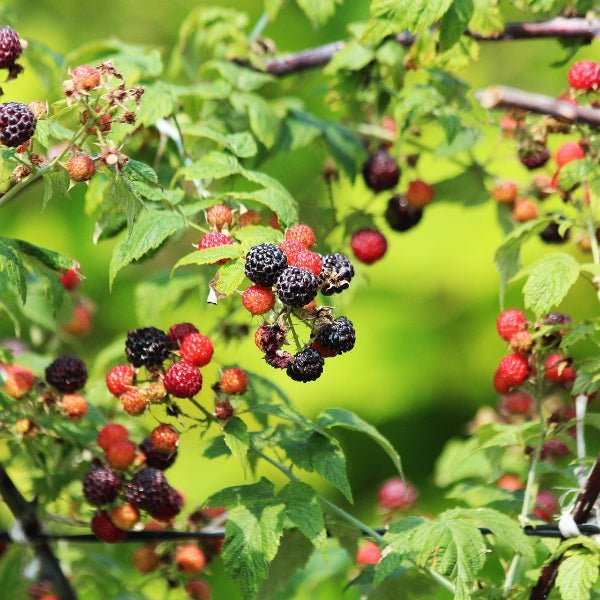
Latin Name: Rubus idaeus
Menominee Name: Anūhkanawīhsyah, translates to "raspberry-bush"
Ojibwe Name: Miskomin
Rubus idaeus, commonly called red raspberry, is, for the most part, an erect to spreading to sprawling, thicket-forming, deciduous shrub with biennial, often prickly, cane-like stems. It typically grows to 3-9’ tall. This species has two main varieties, R. idaeus var. idaeus (European raspberry) which is native to Eurasia and R. idaeus var. strigosa (American red raspberry) which is native to a large part of North America from Alaska and Canada south to California, Oklahoma and North Carolina. In the wild, raspberries typically grow in a variety of locations including open woods, ravines, heaths, stream banks, bluffs and wooded mountain slopes. Commercially grown raspberries are mostly cultivars of these varieties or crosses between the two.
Raspberry shrubs are primarily grown for harvesting the tasty fruits. Leaves are alternate, usually divided into 3-5 leaflets which are arranged pinnately, pedately, or less commonly palmately, but infrequently undivided. First year stems (primocanes) bear only leaves. Lateral branches in the second year (floricanes) produce leaves, flowers and fruits. Flowers are in clusters, racemes or panicles, but are occasionally solitary, and are generally white but sometimes pink to rosy-purple. Flowers bloom in spring. Each flower has five petals, five sepals, five bracts, numerous stamens, and several pistils clustered on a cone-shaped core known as a receptacle. Botanically the fruits are not berries (though they are usually called berries), but are coherent aggregations of tiny drupelets. Fruits separate from the receptacle when picked with each raspberry resembling a hollow cone. Fruits ripen in summer. Many wild raspberries have very little garden merit, and, if not properly cared for, can easily spread to form tangled masses of impenetrable, thorny stems.
Genus name is the Latin name for brambles (blackberry and raspberry). (Source: Missouri Botanical Garden Plant Finder)
Common Elderberry

Latin Name: Sambucus canadensis
Menominee Name: Pāpāskecisekanāhtek, translates to "gun tree"
Ojibwe Name: Bibiwemin
Arctic Fire Dogwood
Latin Name: Cornus sericea
Menominee Name: Mayāmaehkuahkwah, translates to "red woody bush"
Cornus sericea, commonly known as red twig dogwood or red osier dogwood, is an upright-spreading, suckering shrub that typically grows in the absence of pruning to 6-9’ tall with a slightly larger spread. With the exception of the lower midwest and deep South, this species is native to much of North America where it is typically found growing in wet swampy areas, wetland margins or along lakes and rivers. Ovate to lanceolate, medium to dark green leaves (2-5” long) acquire interesting shades of red to orange eventually fading to purple in autumn. Reddish stems turn bright red in winter and are particularly showy against a snowy backdrop. Tiny, fragrant, white flowers appear in flat-topped clusters (cymes to 2.5” diameter) in late spring, with sparse, intermittent, additional flowering sometimes continuing into summer. Flowers give way to clusters of whitish (sometimes with a bluish tinge) drupes in summer. Fruit is quite attractive to birds and is generally considered to have as much if not more ornamental interest than the flowers.
Red stems somewhat resemble the reddish stems of some osier willows, hence the common name of red osier dogwood. Some cultivars of this species (e.g., C. sericea 'Flaviramia') have yellow stems.
Synonymous with and formerly known as Cornus stolonifera.
Genus name comes from the Latin word cornus meaning "horn", possibly in reference to the strength and density of the wood. Cornus is also the Latin name for cornelian cherry (Cornus mas). May also be related to the Greek kerasos meaning "cherry".
Specific epithet from Latin means silky in reference to the hairs present on young twigs and upper leaf surfaces.
'Farrow', commonly sold as ARCTIC FIRE, is a dwarf redtwig dogwood cultivar that is primarily grown for its bright red winter stems. It typically grows to 3-4’ tall and as wide with dense stems. It lacks the stoloniferous, spreading habit of the species. U. S. Plant Patent Applied For (PPAF). (Source: Missouri Botanical Garden Plant Finder)
Wild Leek
Latin Name: Allium tricoccum
Menominee Name: Pekuac-sekākūhsyah, translates to "wild skunk plant" due to its strong smell.
This is the plant for which Chicago is named. In Illinois Indian language, its name was Chicagoua. This name probably was applied as a metaphor for the skunk-like odor of the leaves when crushed by walking on them. Chicagoua basically means skunk, from the spraying of defensive liquid. Contrary to popular belief, it does not mean offensive odor, which would be matchi miaganoue. This information appears in 17th-century Jesuit linguistic manuscripts.
The leaves emerge in April, and then the plant is edible; but when flowers emerge, the flavor turns very pungent, and most people would deem it inedible. If eaten at this flowering stage or later in its life cycle, it produces a highly odorific breath which must be experienced to be believed. (Source: Chicago Botanic Garden)
Narrowleaf Bluestar

Latin Name: Amsonia hubrichtii
Narrowleaf Bluestar is native to Arkansas and Oklahoma and was identified and named in the wild in 1942 by Leslie Hubricht. Its fine, soft texture and threadlike foliage has helped win its place in cultivation. It is perhaps best known for its golden and persistent fall color that appears to be almost a golden cloud. Arkansas amsonia was chosen Perennial Plant of the Year in 2011.
Members of the genus Amsonia are commonly known as bluestars for the abundant small blue flowers borne in clusters at the stem tips in late spring or early summer. The foliage ranges from threadlike to willow-like and looks attractive throughout the growing season with the bonus of good to outstanding yellow to gold fall color. Species may vary in plant size from a ground cover sized 5 inches to an almost shrub sized 4 feet. Bluestars are considered easy-to-grow, long-lived perennials tolerant of many soil types. (Source: Chicago Botanic Garden)
Narrowleaf Bluestar
Latin Name: Amsonia hubrichtii
Narrowleaf Bluestar is native to Arkansas and Oklahoma and was identified and named in the wild in 1942 by Leslie Hubricht. Its fine, soft texture and threadlike foliage has helped win its place in cultivation. It is perhaps best known for its golden and persistent fall color that appears to be almost a golden cloud. Arkansas amsonia was chosen Perennial Plant of the Year in 2011.
Members of the genus Amsonia are commonly known as bluestars for the abundant small blue flowers borne in clusters at the stem tips in late spring or early summer. The foliage ranges from threadlike to willow-like and looks attractive throughout the growing season with the bonus of good to outstanding yellow to gold fall color. Species may vary in plant size from a ground cover sized 5 inches to an almost shrub sized 4 feet. Bluestars are considered easy-to-grow, long-lived perennials tolerant of many soil types. (Source: Chicago Botanic Garden)
Narrowleaf Bluestar
Latin Name: Amsonia hubrichtii
Narrowleaf Bluestar is native to Arkansas and Oklahoma and was identified and named in the wild in 1942 by Leslie Hubricht. Its fine, soft texture and threadlike foliage has helped win its place in cultivation. It is perhaps best known for its golden and persistent fall color that appears to be almost a golden cloud. Arkansas amsonia was chosen Perennial Plant of the Year in 2011.
Members of the genus Amsonia are commonly known as bluestars for the abundant small blue flowers borne in clusters at the stem tips in late spring or early summer. The foliage ranges from threadlike to willow-like and looks attractive throughout the growing season with the bonus of good to outstanding yellow to gold fall color. Species may vary in plant size from a ground cover sized 5 inches to an almost shrub sized 4 feet. Bluestars are considered easy-to-grow, long-lived perennials tolerant of many soil types. (Source: Chicago Botanic Garden)
Narrowleaf Bluestar
Latin Name: Amsonia hubrichtii
Narrowleaf Bluestar is native to Arkansas and Oklahoma and was identified and named in the wild in 1942 by Leslie Hubricht. Its fine, soft texture and threadlike foliage has helped win its place in cultivation. It is perhaps best known for its golden and persistent fall color that appears to be almost a golden cloud. Arkansas amsonia was chosen Perennial Plant of the Year in 2011.
Members of the genus Amsonia are commonly known as bluestars for the abundant small blue flowers borne in clusters at the stem tips in late spring or early summer. The foliage ranges from threadlike to willow-like and looks attractive throughout the growing season with the bonus of good to outstanding yellow to gold fall color. Species may vary in plant size from a ground cover sized 5 inches to an almost shrub sized 4 feet. Bluestars are considered easy-to-grow, long-lived perennials tolerant of many soil types. (Source: Chicago Botanic Garden)
Pasque Flower
Latin Name: Anemone patens
Menominee Name: Wāēsāwīmiawaskōhsaeh
Anemone patens, commonly called Pasque flower, is an early spring wildflower that features silky, hairy, fern-like foliage and erect, open bell-shaped, solitary, blue-violet (but occasionally yellow or white) flowers. Leafless, hairy flower stems emerge from the ground in spring (March-April in St. Louis), sometimes when patches of snow are still on the ground. Flowers bloom as the foliage begins to form. When the flowers appear, stems are typically only 4-5” tall. Stems elongate and foliage grows taller after bloom, with plants typically maturing to 8-12” tall. Deeply divided basal foliage is silvery-hairy. Flowers are followed by plume-like seedheads (reminiscent of some clematis and geum) that have good ornamental interest. This species and varieties thereof are native to prairies, sub-alpine meadows and dry rocky areas in northern Europe, Siberia and North America (Alaska south to Washington, New Mexico, Texas and Illinois). This is the one of the first spring flowers to bloom on the northern Great Plains and far northern tundra areas.
Pasque Flower
Latin Name: Anemone patens
Menominee Name: Wāēsāwīmiawaskōhsaeh
Anemone patens, commonly called Pasque flower, is an early spring wildflower that features silky, hairy, fern-like foliage and erect, open bell-shaped, solitary, blue-violet (but occasionally yellow or white) flowers. Leafless, hairy flower stems emerge from the ground in spring (March-April in St. Louis), sometimes when patches of snow are still on the ground. Flowers bloom as the foliage begins to form. When the flowers appear, stems are typically only 4-5” tall. Stems elongate and foliage grows taller after bloom, with plants typically maturing to 8-12” tall. Deeply divided basal foliage is silvery-hairy. Flowers are followed by plume-like seedheads (reminiscent of some clematis and geum) that have good ornamental interest. This species and varieties thereof are native to prairies, sub-alpine meadows and dry rocky areas in northern Europe, Siberia and North America (Alaska south to Washington, New Mexico, Texas and Illinois). This is the one of the first spring flowers to bloom on the northern Great Plains and far northern tundra areas.
Pasque Flower
Latin Name: Anemone patens
Menominee Name: Wāēsāwīmiawaskōhsaeh
Anemone patens, commonly called Pasque flower, is an early spring wildflower that features silky, hairy, fern-like foliage and erect, open bell-shaped, solitary, blue-violet (but occasionally yellow or white) flowers. Leafless, hairy flower stems emerge from the ground in spring (March-April in St. Louis), sometimes when patches of snow are still on the ground. Flowers bloom as the foliage begins to form. When the flowers appear, stems are typically only 4-5” tall. Stems elongate and foliage grows taller after bloom, with plants typically maturing to 8-12” tall. Deeply divided basal foliage is silvery-hairy. Flowers are followed by plume-like seedheads (reminiscent of some clematis and geum) that have good ornamental interest. This species and varieties thereof are native to prairies, sub-alpine meadows and dry rocky areas in northern Europe, Siberia and North America (Alaska south to Washington, New Mexico, Texas and Illinois). This is the one of the first spring flowers to bloom on the northern Great Plains and far northern tundra areas.
Pasque Flower
Latin Name: Anemone patens
Menominee Name: Wāēsāwīmiawaskōhsaeh
Anemone patens, commonly called Pasque flower, is an early spring wildflower that features silky, hairy, fern-like foliage and erect, open bell-shaped, solitary, blue-violet (but occasionally yellow or white) flowers. Leafless, hairy flower stems emerge from the ground in spring (March-April in St. Louis), sometimes when patches of snow are still on the ground. Flowers bloom as the foliage begins to form. When the flowers appear, stems are typically only 4-5” tall. Stems elongate and foliage grows taller after bloom, with plants typically maturing to 8-12” tall. Deeply divided basal foliage is silvery-hairy. Flowers are followed by plume-like seedheads (reminiscent of some clematis and geum) that have good ornamental interest. This species and varieties thereof are native to prairies, sub-alpine meadows and dry rocky areas in northern Europe, Siberia and North America (Alaska south to Washington, New Mexico, Texas and Illinois). This is the one of the first spring flowers to bloom on the northern Great Plains and far northern tundra areas.
Pasque Flower
Latin Name: Anemone patens
Menominee Name: Wāēsāwīmiawaskōhsaeh
Anemone patens, commonly called Pasque flower, is an early spring wildflower that features silky, hairy, fern-like foliage and erect, open bell-shaped, solitary, blue-violet (but occasionally yellow or white) flowers. Leafless, hairy flower stems emerge from the ground in spring (March-April in St. Louis), sometimes when patches of snow are still on the ground. Flowers bloom as the foliage begins to form. When the flowers appear, stems are typically only 4-5” tall. Stems elongate and foliage grows taller after bloom, with plants typically maturing to 8-12” tall. Deeply divided basal foliage is silvery-hairy. Flowers are followed by plume-like seedheads (reminiscent of some clematis and geum) that have good ornamental interest. This species and varieties thereof are native to prairies, sub-alpine meadows and dry rocky areas in northern Europe, Siberia and North America (Alaska south to Washington, New Mexico, Texas and Illinois). This is the one of the first spring flowers to bloom on the northern Great Plains and far northern tundra areas.
Pasque Flower
Latin Name: Anemone patens
Menominee Name: Wāēsāwīmiawaskōhsaeh
Anemone patens, commonly called Pasque flower, is an early spring wildflower that features silky, hairy, fern-like foliage and erect, open bell-shaped, solitary, blue-violet (but occasionally yellow or white) flowers. Leafless, hairy flower stems emerge from the ground in spring (March-April in St. Louis), sometimes when patches of snow are still on the ground. Flowers bloom as the foliage begins to form. When the flowers appear, stems are typically only 4-5” tall. Stems elongate and foliage grows taller after bloom, with plants typically maturing to 8-12” tall. Deeply divided basal foliage is silvery-hairy. Flowers are followed by plume-like seedheads (reminiscent of some clematis and geum) that have good ornamental interest. This species and varieties thereof are native to prairies, sub-alpine meadows and dry rocky areas in northern Europe, Siberia and North America (Alaska south to Washington, New Mexico, Texas and Illinois). This is the one of the first spring flowers to bloom on the northern Great Plains and far northern tundra areas.
Pasque Flower
Latin Name: Anemone patens
Menominee Name: Wāēsāwīmiawaskōhsaeh
Anemone patens, commonly called Pasque flower, is an early spring wildflower that features silky, hairy, fern-like foliage and erect, open bell-shaped, solitary, blue-violet (but occasionally yellow or white) flowers. Leafless, hairy flower stems emerge from the ground in spring (March-April in St. Louis), sometimes when patches of snow are still on the ground. Flowers bloom as the foliage begins to form. When the flowers appear, stems are typically only 4-5” tall. Stems elongate and foliage grows taller after bloom, with plants typically maturing to 8-12” tall. Deeply divided basal foliage is silvery-hairy. Flowers are followed by plume-like seedheads (reminiscent of some clematis and geum) that have good ornamental interest. This species and varieties thereof are native to prairies, sub-alpine meadows and dry rocky areas in northern Europe, Siberia and North America (Alaska south to Washington, New Mexico, Texas and Illinois). This is the one of the first spring flowers to bloom on the northern Great Plains and far northern tundra areas.
Wild Columbine
Latin Name: Aquilegia canadensis
Menominee Name: Naeqnāēckah mayēcek, "the one the hummingbird eats"
Aquilegia canadensis is a Missouri native spring wildflower which occurs in rocky woods, slopes, ledges and open areas throughout the State. Features drooping, bell-like, 1-2", red and yellow flowers (red sepals, yellow-limbed petals, 5 distinctive red spurs and a mass of bushy yellow stamens). Delicate, biternate foliage is somewhat suggestive of meadow rue (Thalictrum) and remains attractive throughout the summer as long as soils are kept moist. Flowers are quite attractive to hummingbirds.
Butterfly Weed
Latin Name: Asclepias tuberosa
Menominee Name: Nāēnawīhsaeh
Asclepias tuberosa, commonly called butterfly weed, is a tuberous rooted, Missouri native perennial which occurs in dry/rocky open woods, glades, prairies, fields and roadsides throughout the State (Steyermark). It typically grows in a clump to 1-2.5' tall and features clusters (umbels) of bright orange to yellow-orange flowers atop upright to reclining, hairy stems with narrow, lance-shaped leaves. Unlike many of the other milkweeds, this species does not have milky-sapped stems. Flowers give way to prominent, spindle-shaped seed pods (3-6" long) which split open when ripe releasing numerous silky-tailed seeds for dispersal by the wind. Seed pods are valued in dried flower arrangements. Long bloom period from late spring throughout the summer. Flowers are a nectar source for hummingbirds, butterflies and many other pollinators, and leaves are a food source for monarch butterfly larvae (caterpillars).
The charismatic and imperiled monarch butterfly requires milkweed plants in order to survive. Monarchs migrate into the eastern U.S. from Mexico in spring to lay their eggs on milkweed species plants. Caterpillars hatch from the eggs and consume the milkweed plant foliage as food for growth and development. Mature caterpillars will search for a nearby, sheltered location to enter the pupal stage and form a chrysalis. Inside, they will complete metamorphosis and emerge as an adult butterfly in around 2 weeks. Flower nectar is consumed by adult butterflies as a valuable food source. The 4th or 5th generation of monarch butterflies that emerges in August-September will migrate into Mexico to overwinter as adults. Significant declines in monarch butterfly populations in North America over the course of the 21st century are believed by many experts to be caused by a reduction in milkweed due to widespread use of herbicide-tolerant row crops, climate change, and loss of overwinter sites due to habitat destruction.
Butterfly Weed
Latin Name: Asclepias tuberosa
Menominee Name: Nāēnawīhsaeh
Asclepias tuberosa, commonly called butterfly weed, is a tuberous rooted, Missouri native perennial which occurs in dry/rocky open woods, glades, prairies, fields and roadsides throughout the State (Steyermark). It typically grows in a clump to 1-2.5' tall and features clusters (umbels) of bright orange to yellow-orange flowers atop upright to reclining, hairy stems with narrow, lance-shaped leaves. Unlike many of the other milkweeds, this species does not have milky-sapped stems. Flowers give way to prominent, spindle-shaped seed pods (3-6" long) which split open when ripe releasing numerous silky-tailed seeds for dispersal by the wind. Seed pods are valued in dried flower arrangements. Long bloom period from late spring throughout the summer. Flowers are a nectar source for hummingbirds, butterflies and many other pollinators, and leaves are a food source for monarch butterfly larvae (caterpillars).
The charismatic and imperiled monarch butterfly requires milkweed plants in order to survive. Monarchs migrate into the eastern U.S. from Mexico in spring to lay their eggs on milkweed species plants. Caterpillars hatch from the eggs and consume the milkweed plant foliage as food for growth and development. Mature caterpillars will search for a nearby, sheltered location to enter the pupal stage and form a chrysalis. Inside, they will complete metamorphosis and emerge as an adult butterfly in around 2 weeks. Flower nectar is consumed by adult butterflies as a valuable food source. The 4th or 5th generation of monarch butterflies that emerges in August-September will migrate into Mexico to overwinter as adults. Significant declines in monarch butterfly populations in North America over the course of the 21st century are believed by many experts to be caused by a reduction in milkweed due to widespread use of herbicide-tolerant row crops, climate change, and loss of overwinter sites due to habitat destruction.
Butterfly Weed
Latin Name: Asclepias tuberosa
Menominee Name: Nāēnawīhsaeh
Asclepias tuberosa, commonly called butterfly weed, is a tuberous rooted, Missouri native perennial which occurs in dry/rocky open woods, glades, prairies, fields and roadsides throughout the State (Steyermark). It typically grows in a clump to 1-2.5' tall and features clusters (umbels) of bright orange to yellow-orange flowers atop upright to reclining, hairy stems with narrow, lance-shaped leaves. Unlike many of the other milkweeds, this species does not have milky-sapped stems. Flowers give way to prominent, spindle-shaped seed pods (3-6" long) which split open when ripe releasing numerous silky-tailed seeds for dispersal by the wind. Seed pods are valued in dried flower arrangements. Long bloom period from late spring throughout the summer. Flowers are a nectar source for hummingbirds, butterflies and many other pollinators, and leaves are a food source for monarch butterfly larvae (caterpillars).
The charismatic and imperiled monarch butterfly requires milkweed plants in order to survive. Monarchs migrate into the eastern U.S. from Mexico in spring to lay their eggs on milkweed species plants. Caterpillars hatch from the eggs and consume the milkweed plant foliage as food for growth and development. Mature caterpillars will search for a nearby, sheltered location to enter the pupal stage and form a chrysalis. Inside, they will complete metamorphosis and emerge as an adult butterfly in around 2 weeks. Flower nectar is consumed by adult butterflies as a valuable food source. The 4th or 5th generation of monarch butterflies that emerges in August-September will migrate into Mexico to overwinter as adults. Significant declines in monarch butterfly populations in North America over the course of the 21st century are believed by many experts to be caused by a reduction in milkweed due to widespread use of herbicide-tolerant row crops, climate change, and loss of overwinter sites due to habitat destruction.
Butterfly Weed
Latin Name: Asclepias tuberosa
Menominee Name: Nāēnawīhsaeh
Asclepias tuberosa, commonly called butterfly weed, is a tuberous rooted, Missouri native perennial which occurs in dry/rocky open woods, glades, prairies, fields and roadsides throughout the State (Steyermark). It typically grows in a clump to 1-2.5' tall and features clusters (umbels) of bright orange to yellow-orange flowers atop upright to reclining, hairy stems with narrow, lance-shaped leaves. Unlike many of the other milkweeds, this species does not have milky-sapped stems. Flowers give way to prominent, spindle-shaped seed pods (3-6" long) which split open when ripe releasing numerous silky-tailed seeds for dispersal by the wind. Seed pods are valued in dried flower arrangements. Long bloom period from late spring throughout the summer. Flowers are a nectar source for hummingbirds, butterflies and many other pollinators, and leaves are a food source for monarch butterfly larvae (caterpillars).
The charismatic and imperiled monarch butterfly requires milkweed plants in order to survive. Monarchs migrate into the eastern U.S. from Mexico in spring to lay their eggs on milkweed species plants. Caterpillars hatch from the eggs and consume the milkweed plant foliage as food for growth and development. Mature caterpillars will search for a nearby, sheltered location to enter the pupal stage and form a chrysalis. Inside, they will complete metamorphosis and emerge as an adult butterfly in around 2 weeks. Flower nectar is consumed by adult butterflies as a valuable food source. The 4th or 5th generation of monarch butterflies that emerges in August-September will migrate into Mexico to overwinter as adults. Significant declines in monarch butterfly populations in North America over the course of the 21st century are believed by many experts to be caused by a reduction in milkweed due to widespread use of herbicide-tolerant row crops, climate change, and loss of overwinter sites due to habitat destruction.
Butterfly Weed
Latin Name: Asclepias tuberosa
Menominee Name: Nāēnawīhsaeh
Asclepias tuberosa, commonly called butterfly weed, is a tuberous rooted, Missouri native perennial which occurs in dry/rocky open woods, glades, prairies, fields and roadsides throughout the State (Steyermark). It typically grows in a clump to 1-2.5' tall and features clusters (umbels) of bright orange to yellow-orange flowers atop upright to reclining, hairy stems with narrow, lance-shaped leaves. Unlike many of the other milkweeds, this species does not have milky-sapped stems. Flowers give way to prominent, spindle-shaped seed pods (3-6" long) which split open when ripe releasing numerous silky-tailed seeds for dispersal by the wind. Seed pods are valued in dried flower arrangements. Long bloom period from late spring throughout the summer. Flowers are a nectar source for hummingbirds, butterflies and many other pollinators, and leaves are a food source for monarch butterfly larvae (caterpillars).
The charismatic and imperiled monarch butterfly requires milkweed plants in order to survive. Monarchs migrate into the eastern U.S. from Mexico in spring to lay their eggs on milkweed species plants. Caterpillars hatch from the eggs and consume the milkweed plant foliage as food for growth and development. Mature caterpillars will search for a nearby, sheltered location to enter the pupal stage and form a chrysalis. Inside, they will complete metamorphosis and emerge as an adult butterfly in around 2 weeks. Flower nectar is consumed by adult butterflies as a valuable food source. The 4th or 5th generation of monarch butterflies that emerges in August-September will migrate into Mexico to overwinter as adults. Significant declines in monarch butterfly populations in North America over the course of the 21st century are believed by many experts to be caused by a reduction in milkweed due to widespread use of herbicide-tolerant row crops, climate change, and loss of overwinter sites due to habitat destruction.
Butterfly Weed
Latin Name: Asclepias tuberosa
Menominee Name: Nāēnawīhsaeh
Asclepias tuberosa, commonly called butterfly weed, is a tuberous rooted, Missouri native perennial which occurs in dry/rocky open woods, glades, prairies, fields and roadsides throughout the State (Steyermark). It typically grows in a clump to 1-2.5' tall and features clusters (umbels) of bright orange to yellow-orange flowers atop upright to reclining, hairy stems with narrow, lance-shaped leaves. Unlike many of the other milkweeds, this species does not have milky-sapped stems. Flowers give way to prominent, spindle-shaped seed pods (3-6" long) which split open when ripe releasing numerous silky-tailed seeds for dispersal by the wind. Seed pods are valued in dried flower arrangements. Long bloom period from late spring throughout the summer. Flowers are a nectar source for hummingbirds, butterflies and many other pollinators, and leaves are a food source for monarch butterfly larvae (caterpillars).
The charismatic and imperiled monarch butterfly requires milkweed plants in order to survive. Monarchs migrate into the eastern U.S. from Mexico in spring to lay their eggs on milkweed species plants. Caterpillars hatch from the eggs and consume the milkweed plant foliage as food for growth and development. Mature caterpillars will search for a nearby, sheltered location to enter the pupal stage and form a chrysalis. Inside, they will complete metamorphosis and emerge as an adult butterfly in around 2 weeks. Flower nectar is consumed by adult butterflies as a valuable food source. The 4th or 5th generation of monarch butterflies that emerges in August-September will migrate into Mexico to overwinter as adults. Significant declines in monarch butterfly populations in North America over the course of the 21st century are believed by many experts to be caused by a reduction in milkweed due to widespread use of herbicide-tolerant row crops, climate change, and loss of overwinter sites due to habitat destruction.
Butterfly Weed
Latin Name: Asclepias tuberosa
Menominee Name: Nāēnawīhsaeh
Asclepias tuberosa, commonly called butterfly weed, is a tuberous rooted, Missouri native perennial which occurs in dry/rocky open woods, glades, prairies, fields and roadsides throughout the State (Steyermark). It typically grows in a clump to 1-2.5' tall and features clusters (umbels) of bright orange to yellow-orange flowers atop upright to reclining, hairy stems with narrow, lance-shaped leaves. Unlike many of the other milkweeds, this species does not have milky-sapped stems. Flowers give way to prominent, spindle-shaped seed pods (3-6" long) which split open when ripe releasing numerous silky-tailed seeds for dispersal by the wind. Seed pods are valued in dried flower arrangements. Long bloom period from late spring throughout the summer. Flowers are a nectar source for hummingbirds, butterflies and many other pollinators, and leaves are a food source for monarch butterfly larvae (caterpillars).
The charismatic and imperiled monarch butterfly requires milkweed plants in order to survive. Monarchs migrate into the eastern U.S. from Mexico in spring to lay their eggs on milkweed species plants. Caterpillars hatch from the eggs and consume the milkweed plant foliage as food for growth and development. Mature caterpillars will search for a nearby, sheltered location to enter the pupal stage and form a chrysalis. Inside, they will complete metamorphosis and emerge as an adult butterfly in around 2 weeks. Flower nectar is consumed by adult butterflies as a valuable food source. The 4th or 5th generation of monarch butterflies that emerges in August-September will migrate into Mexico to overwinter as adults. Significant declines in monarch butterfly populations in North America over the course of the 21st century are believed by many experts to be caused by a reduction in milkweed due to widespread use of herbicide-tolerant row crops, climate change, and loss of overwinter sites due to habitat destruction.
Butterfly Weed
Latin Name: Asclepias tuberosa
Menominee Name: Nāēnawīhsaeh
Asclepias tuberosa, commonly called butterfly weed, is a tuberous rooted, Missouri native perennial which occurs in dry/rocky open woods, glades, prairies, fields and roadsides throughout the State (Steyermark). It typically grows in a clump to 1-2.5' tall and features clusters (umbels) of bright orange to yellow-orange flowers atop upright to reclining, hairy stems with narrow, lance-shaped leaves. Unlike many of the other milkweeds, this species does not have milky-sapped stems. Flowers give way to prominent, spindle-shaped seed pods (3-6" long) which split open when ripe releasing numerous silky-tailed seeds for dispersal by the wind. Seed pods are valued in dried flower arrangements. Long bloom period from late spring throughout the summer. Flowers are a nectar source for hummingbirds, butterflies and many other pollinators, and leaves are a food source for monarch butterfly larvae (caterpillars).
The charismatic and imperiled monarch butterfly requires milkweed plants in order to survive. Monarchs migrate into the eastern U.S. from Mexico in spring to lay their eggs on milkweed species plants. Caterpillars hatch from the eggs and consume the milkweed plant foliage as food for growth and development. Mature caterpillars will search for a nearby, sheltered location to enter the pupal stage and form a chrysalis. Inside, they will complete metamorphosis and emerge as an adult butterfly in around 2 weeks. Flower nectar is consumed by adult butterflies as a valuable food source. The 4th or 5th generation of monarch butterflies that emerges in August-September will migrate into Mexico to overwinter as adults. Significant declines in monarch butterfly populations in North America over the course of the 21st century are believed by many experts to be caused by a reduction in milkweed due to widespread use of herbicide-tolerant row crops, climate change, and loss of overwinter sites due to habitat destruction.
Butterfly Weed
Latin Name: Asclepias tuberosa
Menominee Name: Nāēnawīhsaeh
Asclepias tuberosa, commonly called butterfly weed, is a tuberous rooted, Missouri native perennial which occurs in dry/rocky open woods, glades, prairies, fields and roadsides throughout the State (Steyermark). It typically grows in a clump to 1-2.5' tall and features clusters (umbels) of bright orange to yellow-orange flowers atop upright to reclining, hairy stems with narrow, lance-shaped leaves. Unlike many of the other milkweeds, this species does not have milky-sapped stems. Flowers give way to prominent, spindle-shaped seed pods (3-6" long) which split open when ripe releasing numerous silky-tailed seeds for dispersal by the wind. Seed pods are valued in dried flower arrangements. Long bloom period from late spring throughout the summer. Flowers are a nectar source for hummingbirds, butterflies and many other pollinators, and leaves are a food source for monarch butterfly larvae (caterpillars).
The charismatic and imperiled monarch butterfly requires milkweed plants in order to survive. Monarchs migrate into the eastern U.S. from Mexico in spring to lay their eggs on milkweed species plants. Caterpillars hatch from the eggs and consume the milkweed plant foliage as food for growth and development. Mature caterpillars will search for a nearby, sheltered location to enter the pupal stage and form a chrysalis. Inside, they will complete metamorphosis and emerge as an adult butterfly in around 2 weeks. Flower nectar is consumed by adult butterflies as a valuable food source. The 4th or 5th generation of monarch butterflies that emerges in August-September will migrate into Mexico to overwinter as adults. Significant declines in monarch butterfly populations in North America over the course of the 21st century are believed by many experts to be caused by a reduction in milkweed due to widespread use of herbicide-tolerant row crops, climate change, and loss of overwinter sites due to habitat destruction.
Blue False Indigo
Latin Name: Baptisia australis
Menominee Name: Pāēsekokasiwaskinākwat, "looks like lupine"
Baptisia australis, commonly called blue false indigo, is an upright perennial which typically grows 3-4' tall and occurs in rich woods, thickets and along streambanks from Pennsylvania south to North Carolina and Tennessee. It features purple, lupine-like flowers in erect racemes (to 12") atop flower spikes extending well above a foliage mound of clover-like, trifoliate, bluish-green leaves (leaflets to 2" long). Blooms in spring. Flowers give way to inflated seed pods (to 2.5" long) which turn charcoal black when ripe and have considerable ornamental interest. Seeds rattle around in the blackened pods which were once popularly used by children as rattles. Stems with seed pods are valued additions to dried flower arrangements.
Blue False Indigo
Latin Name: Baptisia australis
Menominee Name: Pāēsekokasiwaskinākwat, "looks like lupine"
Baptisia australis, commonly called blue false indigo, is an upright perennial which typically grows 3-4' tall and occurs in rich woods, thickets and along streambanks from Pennsylvania south to North Carolina and Tennessee. It features purple, lupine-like flowers in erect racemes (to 12") atop flower spikes extending well above a foliage mound of clover-like, trifoliate, bluish-green leaves (leaflets to 2" long). Blooms in spring. Flowers give way to inflated seed pods (to 2.5" long) which turn charcoal black when ripe and have considerable ornamental interest. Seeds rattle around in the blackened pods which were once popularly used by children as rattles. Stems with seed pods are valued additions to dried flower arrangements.
Blue False Indigo
Latin Name: Baptisia australis
Menominee Name: Pāēsekokasiwaskinākwat, "looks like lupine"
Baptisia australis, commonly called blue false indigo, is an upright perennial which typically grows 3-4' tall and occurs in rich woods, thickets and along streambanks from Pennsylvania south to North Carolina and Tennessee. It features purple, lupine-like flowers in erect racemes (to 12") atop flower spikes extending well above a foliage mound of clover-like, trifoliate, bluish-green leaves (leaflets to 2" long). Blooms in spring. Flowers give way to inflated seed pods (to 2.5" long) which turn charcoal black when ripe and have considerable ornamental interest. Seeds rattle around in the blackened pods which were once popularly used by children as rattles. Stems with seed pods are valued additions to dried flower arrangements.
Blue False Indigo
Latin Name: Baptisia australis
Menominee Name: Pāēsekokasiwaskinākwat, "looks like lupine"
Baptisia australis, commonly called blue false indigo, is an upright perennial which typically grows 3-4' tall and occurs in rich woods, thickets and along streambanks from Pennsylvania south to North Carolina and Tennessee. It features purple, lupine-like flowers in erect racemes (to 12") atop flower spikes extending well above a foliage mound of clover-like, trifoliate, bluish-green leaves (leaflets to 2" long). Blooms in spring. Flowers give way to inflated seed pods (to 2.5" long) which turn charcoal black when ripe and have considerable ornamental interest. Seeds rattle around in the blackened pods which were once popularly used by children as rattles. Stems with seed pods are valued additions to dried flower arrangements.
Blue False Indigo
Latin Name: Baptisia australis
Menominee Name: Pāēsekokasiwaskinākwat, "looks like lupine"
Baptisia australis, commonly called blue false indigo, is an upright perennial which typically grows 3-4' tall and occurs in rich woods, thickets and along streambanks from Pennsylvania south to North Carolina and Tennessee. It features purple, lupine-like flowers in erect racemes (to 12") atop flower spikes extending well above a foliage mound of clover-like, trifoliate, bluish-green leaves (leaflets to 2" long). Blooms in spring. Flowers give way to inflated seed pods (to 2.5" long) which turn charcoal black when ripe and have considerable ornamental interest. Seeds rattle around in the blackened pods which were once popularly used by children as rattles. Stems with seed pods are valued additions to dried flower arrangements.
Baptisia 'Mojito'
Latin Name: Baptisia australis 'Mojito'
Menominee Name: Wāpepaesekokasiwaskinākwat, "looks like white lupine"
Mojito false indigo is a Chicagoland Grows® selection. Chicagoland Grows® is a plant introduction partnership of the Chicago Botanic Garden, the Morton Arboretum and the Ornamental Growers Association of Northern Illinois formed to promote plant cultivars that perform well in northern Illinois. This variety was developed at the Chicago Botanic Garden; it was selected for its heavy flower production, vase-shaped habit that becomes more mounded as the season progresses, and light lemon flower color. It is part of the PRAIRIEBLUES False Indigo Series.
Members of the genus Baptisia are commonly known as wild or false indigo due to their use by early Americans as a blue dye. Although "indigo" is in the common name, the blooms of native species may be blue, yellow or white and the blooms of newer hybrids may include lavenders and bi-colors. The late spring or early summer flowers emerge along long stems held above attractive foliage and are followed in the fall by dark pods. Overall habits of the plant are broad-rounded mounds to vase-shaped and range in height from two to five feet. Baptisia are considered easy-to-grow, sun-loving, long-lived perennials with very good drought tolerance once established.
Baptisia are native to North America; there are more than 20 species within the genus. The Chicago Botanic Garden's collection includes over 60 varieties and more than 9,000 individual plants. A number of new varieties of Baptisia have been developed as part of the Plant Breeding program at the Chicago Botanic Garden. Selection criteria included bloom production, color, habit and plant size. These new cultivars have been introduced to the trade through the Chicagoland Grows® program. The Chicago Botanic Garden now holds the national collection of Baptisia under the auspices of the Plant Collections Network of the American Public Gardens Association.
Baptisia 'Mojito'
Latin Name: Baptisia australis 'Mojito'
Menominee Name: Wāpepaesekokasiwaskinākwat, "looks like white lupine"
Mojito false indigo is a Chicagoland Grows® selection. Chicagoland Grows® is a plant introduction partnership of the Chicago Botanic Garden, the Morton Arboretum and the Ornamental Growers Association of Northern Illinois formed to promote plant cultivars that perform well in northern Illinois. This variety was developed at the Chicago Botanic Garden; it was selected for its heavy flower production, vase-shaped habit that becomes more mounded as the season progresses, and light lemon flower color. It is part of the PRAIRIEBLUES False Indigo Series.
Members of the genus Baptisia are commonly known as wild or false indigo due to their use by early Americans as a blue dye. Although "indigo" is in the common name, the blooms of native species may be blue, yellow or white and the blooms of newer hybrids may include lavenders and bi-colors. The late spring or early summer flowers emerge along long stems held above attractive foliage and are followed in the fall by dark pods. Overall habits of the plant are broad-rounded mounds to vase-shaped and range in height from two to five feet. Baptisia are considered easy-to-grow, sun-loving, long-lived perennials with very good drought tolerance once established.
Baptisia are native to North America; there are more than 20 species within the genus. The Chicago Botanic Garden's collection includes over 60 varieties and more than 9,000 individual plants. A number of new varieties of Baptisia have been developed as part of the Plant Breeding program at the Chicago Botanic Garden. Selection criteria included bloom production, color, habit and plant size. These new cultivars have been introduced to the trade through the Chicagoland Grows® program. The Chicago Botanic Garden now holds the national collection of Baptisia under the auspices of the Plant Collections Network of the American Public Gardens Association.
Baptisia 'Mojito'
Latin Name: Baptisia australis 'Mojito'
Menominee Name: Wāpepaesekokasiwaskinākwat, "looks like white lupine"
Mojito false indigo is a Chicagoland Grows® selection. Chicagoland Grows® is a plant introduction partnership of the Chicago Botanic Garden, the Morton Arboretum and the Ornamental Growers Association of Northern Illinois formed to promote plant cultivars that perform well in northern Illinois. This variety was developed at the Chicago Botanic Garden; it was selected for its heavy flower production, vase-shaped habit that becomes more mounded as the season progresses, and light lemon flower color. It is part of the PRAIRIEBLUES False Indigo Series.
Members of the genus Baptisia are commonly known as wild or false indigo due to their use by early Americans as a blue dye. Although "indigo" is in the common name, the blooms of native species may be blue, yellow or white and the blooms of newer hybrids may include lavenders and bi-colors. The late spring or early summer flowers emerge along long stems held above attractive foliage and are followed in the fall by dark pods. Overall habits of the plant are broad-rounded mounds to vase-shaped and range in height from two to five feet. Baptisia are considered easy-to-grow, sun-loving, long-lived perennials with very good drought tolerance once established.
Baptisia are native to North America; there are more than 20 species within the genus. The Chicago Botanic Garden's collection includes over 60 varieties and more than 9,000 individual plants. A number of new varieties of Baptisia have been developed as part of the Plant Breeding program at the Chicago Botanic Garden. Selection criteria included bloom production, color, habit and plant size. These new cultivars have been introduced to the trade through the Chicagoland Grows® program. The Chicago Botanic Garden now holds the national collection of Baptisia under the auspices of the Plant Collections Network of the American Public Gardens Association.
Baptisia 'Mojito'
Latin Name: Baptisia australis 'Mojito'
Menominee Name: Wāpepaesekokasiwaskinākwat, "looks like white lupine"
Mojito false indigo is a Chicagoland Grows® selection. Chicagoland Grows® is a plant introduction partnership of the Chicago Botanic Garden, the Morton Arboretum and the Ornamental Growers Association of Northern Illinois formed to promote plant cultivars that perform well in northern Illinois. This variety was developed at the Chicago Botanic Garden; it was selected for its heavy flower production, vase-shaped habit that becomes more mounded as the season progresses, and light lemon flower color. It is part of the PRAIRIEBLUES False Indigo Series.
Members of the genus Baptisia are commonly known as wild or false indigo due to their use by early Americans as a blue dye. Although "indigo" is in the common name, the blooms of native species may be blue, yellow or white and the blooms of newer hybrids may include lavenders and bi-colors. The late spring or early summer flowers emerge along long stems held above attractive foliage and are followed in the fall by dark pods. Overall habits of the plant are broad-rounded mounds to vase-shaped and range in height from two to five feet. Baptisia are considered easy-to-grow, sun-loving, long-lived perennials with very good drought tolerance once established.
Baptisia are native to North America; there are more than 20 species within the genus. The Chicago Botanic Garden's collection includes over 60 varieties and more than 9,000 individual plants. A number of new varieties of Baptisia have been developed as part of the Plant Breeding program at the Chicago Botanic Garden. Selection criteria included bloom production, color, habit and plant size. These new cultivars have been introduced to the trade through the Chicagoland Grows® program. The Chicago Botanic Garden now holds the national collection of Baptisia under the auspices of the Plant Collections Network of the American Public Gardens Association.
Baptisia 'Mojito'
Latin Name: Baptisia australis 'Mojito'
Menominee Name: Wāpepaesekokasiwaskinākwat, "looks like white lupine"
Mojito false indigo is a Chicagoland Grows® selection. Chicagoland Grows® is a plant introduction partnership of the Chicago Botanic Garden, the Morton Arboretum and the Ornamental Growers Association of Northern Illinois formed to promote plant cultivars that perform well in northern Illinois. This variety was developed at the Chicago Botanic Garden; it was selected for its heavy flower production, vase-shaped habit that becomes more mounded as the season progresses, and light lemon flower color. It is part of the PRAIRIEBLUES False Indigo Series.
Members of the genus Baptisia are commonly known as wild or false indigo due to their use by early Americans as a blue dye. Although "indigo" is in the common name, the blooms of native species may be blue, yellow or white and the blooms of newer hybrids may include lavenders and bi-colors. The late spring or early summer flowers emerge along long stems held above attractive foliage and are followed in the fall by dark pods. Overall habits of the plant are broad-rounded mounds to vase-shaped and range in height from two to five feet. Baptisia are considered easy-to-grow, sun-loving, long-lived perennials with very good drought tolerance once established.
Baptisia are native to North America; there are more than 20 species within the genus. The Chicago Botanic Garden's collection includes over 60 varieties and more than 9,000 individual plants. A number of new varieties of Baptisia have been developed as part of the Plant Breeding program at the Chicago Botanic Garden. Selection criteria included bloom production, color, habit and plant size. These new cultivars have been introduced to the trade through the Chicagoland Grows® program. The Chicago Botanic Garden now holds the national collection of Baptisia under the auspices of the Plant Collections Network of the American Public Gardens Association.
Wild Hyacinth
Latin Name: Camassia scilloides
|
|
| Camassia scilloides is a striking, spring-blooming perennial native to eastern North America. This bulbous plant produces a basal rosette of strap-shaped, grass-like leaves that emerge in early spring, followed by tall, erect flower spikes reaching 12-24 inches tall. In late spring, the flower stalks burst forth with clusters of showy, star-shaped, blue-violet or white blooms that resemble wild hyacinths. The nectar-rich flowers attract a variety of pollinators, including bees and butterflies. After flowering, the foliage often goes dormant in the summer heat. Atlantic Camas thrives in consistently moist, well-drained soil and partial shade to full sun, depending on the climate. Its bold, architectural form and showy blossoms make Camassia scilloides an excellent choice for planting in borders, meadows, woodland gardens, or the edges of ponds and streams, where its unique flowers can be admired in the spring landscape. (Source: North Short Plant Club) |
Wild Hyacinth
Latin Name: Camassia scilloides
|
|
| Camassia scilloides is a striking, spring-blooming perennial native to eastern North America. This bulbous plant produces a basal rosette of strap-shaped, grass-like leaves that emerge in early spring, followed by tall, erect flower spikes reaching 12-24 inches tall. In late spring, the flower stalks burst forth with clusters of showy, star-shaped, blue-violet or white blooms that resemble wild hyacinths. The nectar-rich flowers attract a variety of pollinators, including bees and butterflies. After flowering, the foliage often goes dormant in the summer heat. Atlantic Camas thrives in consistently moist, well-drained soil and partial shade to full sun, depending on the climate. Its bold, architectural form and showy blossoms make Camassia scilloides an excellent choice for planting in borders, meadows, woodland gardens, or the edges of ponds and streams, where its unique flowers can be admired in the spring landscape. (Source: North Short Plant Club) |
Wild Hyacinth
Latin Name: Camassia scilloides
|
|
| Camassia scilloides is a striking, spring-blooming perennial native to eastern North America. This bulbous plant produces a basal rosette of strap-shaped, grass-like leaves that emerge in early spring, followed by tall, erect flower spikes reaching 12-24 inches tall. In late spring, the flower stalks burst forth with clusters of showy, star-shaped, blue-violet or white blooms that resemble wild hyacinths. The nectar-rich flowers attract a variety of pollinators, including bees and butterflies. After flowering, the foliage often goes dormant in the summer heat. Atlantic Camas thrives in consistently moist, well-drained soil and partial shade to full sun, depending on the climate. Its bold, architectural form and showy blossoms make Camassia scilloides an excellent choice for planting in borders, meadows, woodland gardens, or the edges of ponds and streams, where its unique flowers can be admired in the spring landscape. (Source: North Short Plant Club) |
Wild Hyacinth
Latin Name: Camassia scilloides
|
|
| Camassia scilloides is a striking, spring-blooming perennial native to eastern North America. This bulbous plant produces a basal rosette of strap-shaped, grass-like leaves that emerge in early spring, followed by tall, erect flower spikes reaching 12-24 inches tall. In late spring, the flower stalks burst forth with clusters of showy, star-shaped, blue-violet or white blooms that resemble wild hyacinths. The nectar-rich flowers attract a variety of pollinators, including bees and butterflies. After flowering, the foliage often goes dormant in the summer heat. Atlantic Camas thrives in consistently moist, well-drained soil and partial shade to full sun, depending on the climate. Its bold, architectural form and showy blossoms make Camassia scilloides an excellent choice for planting in borders, meadows, woodland gardens, or the edges of ponds and streams, where its unique flowers can be admired in the spring landscape. (Source: North Shore Plant Club) |
Wild Hyacinth
Latin Name: Camassia scilloides
|
|
| Camassia scilloides is a striking, spring-blooming perennial native to eastern North America. This bulbous plant produces a basal rosette of strap-shaped, grass-like leaves that emerge in early spring, followed by tall, erect flower spikes reaching 12-24 inches tall. In late spring, the flower stalks burst forth with clusters of showy, star-shaped, blue-violet or white blooms that resemble wild hyacinths. The nectar-rich flowers attract a variety of pollinators, including bees and butterflies. After flowering, the foliage often goes dormant in the summer heat. Atlantic Camas thrives in consistently moist, well-drained soil and partial shade to full sun, depending on the climate. Its bold, architectural form and showy blossoms make Camassia scilloides an excellent choice for planting in borders, meadows, woodland gardens, or the edges of ponds and streams, where its unique flowers can be admired in the spring landscape. (Source: North Short Plant Club) |
Wild Hyacinth
Latin Name: Camassia scilloides
|
|
| Camassia scilloides is a striking, spring-blooming perennial native to eastern North America. This bulbous plant produces a basal rosette of strap-shaped, grass-like leaves that emerge in early spring, followed by tall, erect flower spikes reaching 12-24 inches tall. In late spring, the flower stalks burst forth with clusters of showy, star-shaped, blue-violet or white blooms that resemble wild hyacinths. The nectar-rich flowers attract a variety of pollinators, including bees and butterflies. After flowering, the foliage often goes dormant in the summer heat. Atlantic Camas thrives in consistently moist, well-drained soil and partial shade to full sun, depending on the climate. Its bold, architectural form and showy blossoms make Camassia scilloides an excellent choice for planting in borders, meadows, woodland gardens, or the edges of ponds and streams, where its unique flowers can be admired in the spring landscape. (Source: North Short Plant Club) |
Wild Hyacinth
Latin Name: Camassia scilloides
|
|
| Camassia scilloides is a striking, spring-blooming perennial native to eastern North America. This bulbous plant produces a basal rosette of strap-shaped, grass-like leaves that emerge in early spring, followed by tall, erect flower spikes reaching 12-24 inches tall. In late spring, the flower stalks burst forth with clusters of showy, star-shaped, blue-violet or white blooms that resemble wild hyacinths. The nectar-rich flowers attract a variety of pollinators, including bees and butterflies. After flowering, the foliage often goes dormant in the summer heat. Atlantic Camas thrives in consistently moist, well-drained soil and partial shade to full sun, depending on the climate. Its bold, architectural form and showy blossoms make Camassia scilloides an excellent choice for planting in borders, meadows, woodland gardens, or the edges of ponds and streams, where its unique flowers can be admired in the spring landscape. (Source: North Short Plant Club) |
New Jersey Tea
Latin Name: Ceanothus americanus
Menominee Name: Ketāken manāētōw, translates to "Spotted Spirit", and is traditionally used for stomach issues
New Jersey Tea blooms in a spectacular display of fragrant white flowers from June to August. Clusters of tiny blossoms pop open in nearly-synchronized explosions, covering the mounded shrub. Growing between 2 and 3 feet tall, this sturdy little bush flaunts striking dark green foliage that provides visual interest even when not in bloom. The rounded, compact shape lends itself equally well to both traditional landscape design and naturalized pollinator garden aesthetics.
Ceanothus americanus is a nitrogen-fixing species that prefers medium-dry soil but can tolerate rocky conditions. It blooms best in part to full sun. The thick, red-hued roots make it drought-tolerant but difficult to move once established, so choose the site carefully. New Jersey Tea produces flowers on new stems, so any pruning should be done early in the season. Mature shrubs can be cut to the ground in spring to encourage more vigorous growth.
An important host plant for Spring Azure and Summer Azure caterpillars, New Jersey Tea also attracts bees and hummingbirds, and its seeds provide food for wild turkeys and quail. Deer, elk, and rabbits also love to browse this plant, so protection may be necessary, especially when the plant is young. The Xerces Society for Invertebrate Conservation has listed this species as 'Special Value to Native Bees' including the rare Yellow Banded Bumble Bee. It is also listed as a species that ‘Supports Conservation Biological Control.’
This native plant has a lot of historic applications: Native Americans used the roots, flowers, and foliage for a variety of purposes. After the Boston Tea Party, many American colonists steeped its leaves as a flavorful (albeit caffeine-free) alternative to imported tea. This is where the common name, New Jersey Tea, originates.
New Jersey Tea
Latin Name: Ceanothus americanus
Menominee Name: Ketāken manāētōw, translates to "Spotted Spirit", and is traditionally used for stomach issues
New Jersey Tea blooms in a spectacular display of fragrant white flowers from June to August. Clusters of tiny blossoms pop open in nearly-synchronized explosions, covering the mounded shrub. Growing between 2 and 3 feet tall, this sturdy little bush flaunts striking dark green foliage that provides visual interest even when not in bloom. The rounded, compact shape lends itself equally well to both traditional landscape design and naturalized pollinator garden aesthetics.
Ceanothus americanus is a nitrogen-fixing species that prefers medium-dry soil but can tolerate rocky conditions. It blooms best in part to full sun. The thick, red-hued roots make it drought-tolerant but difficult to move once established, so choose the site carefully. New Jersey Tea produces flowers on new stems, so any pruning should be done early in the season. Mature shrubs can be cut to the ground in spring to encourage more vigorous growth.
An important host plant for Spring Azure and Summer Azure caterpillars, New Jersey Tea also attracts bees and hummingbirds, and its seeds provide food for wild turkeys and quail. Deer, elk, and rabbits also love to browse this plant, so protection may be necessary, especially when the plant is young. The Xerces Society for Invertebrate Conservation has listed this species as 'Special Value to Native Bees' including the rare Yellow Banded Bumble Bee. It is also listed as a species that ‘Supports Conservation Biological Control.’
This native plant has a lot of historic applications: Native Americans used the roots, flowers, and foliage for a variety of purposes. After the Boston Tea Party, many American colonists steeped its leaves as a flavorful (albeit caffeine-free) alternative to imported tea. This is where the common name, New Jersey Tea, originates.
New Jersey Tea
Latin Name: Ceanothus americanus
Menominee Name: Ketāken manāētōw, translates to "Spotted Spirit", and is traditionally used for stomach issues
New Jersey Tea blooms in a spectacular display of fragrant white flowers from June to August. Clusters of tiny blossoms pop open in nearly-synchronized explosions, covering the mounded shrub. Growing between 2 and 3 feet tall, this sturdy little bush flaunts striking dark green foliage that provides visual interest even when not in bloom. The rounded, compact shape lends itself equally well to both traditional landscape design and naturalized pollinator garden aesthetics.
Ceanothus americanus is a nitrogen-fixing species that prefers medium-dry soil but can tolerate rocky conditions. It blooms best in part to full sun. The thick, red-hued roots make it drought-tolerant but difficult to move once established, so choose the site carefully. New Jersey Tea produces flowers on new stems, so any pruning should be done early in the season. Mature shrubs can be cut to the ground in spring to encourage more vigorous growth.
An important host plant for Spring Azure and Summer Azure caterpillars, New Jersey Tea also attracts bees and hummingbirds, and its seeds provide food for wild turkeys and quail. Deer, elk, and rabbits also love to browse this plant, so protection may be necessary, especially when the plant is young. The Xerces Society for Invertebrate Conservation has listed this species as 'Special Value to Native Bees' including the rare Yellow Banded Bumble Bee. It is also listed as a species that ‘Supports Conservation Biological Control.’
This native plant has a lot of historic applications: Native Americans used the roots, flowers, and foliage for a variety of purposes. After the Boston Tea Party, many American colonists steeped its leaves as a flavorful (albeit caffeine-free) alternative to imported tea. This is where the common name, New Jersey Tea, originates.
Prairie Coreopsis
Latin Name: Coreopsis palmata
Prairie Coreopsis matures to a height of just 2'. Its root systems are fibrous and long-rhizomatous. Prairie Coreopsis prefers medium to dry soil conditions and is tolerant or poor soil conditions and drought. Its striking yellow flowers bloom for 3-4 weeks, usually in June and July. Dead-heading flowers can prolong bloom time. In addition to attracting many native pollinators, Beekeepers consider all Coreopsis species to be good honey sources. In the past, some American Indian tribes applied boiled Coreopsis seeds to painful areas of their bodies in order to relieve ailments such as rheumatism. Other common names in use include Tickseed, Stiff Tickseed, and Stiff Coreopsis. (Source: Prairie Moon Nursery)
Prairie Coreopsis
Latin Name: Coreopsis palmata
Prairie Coreopsis matures to a height of just 2'. Its root systems are fibrous and long-rhizomatous. Prairie Coreopsis prefers medium to dry soil conditions and is tolerant or poor soil conditions and drought. Its striking yellow flowers bloom for 3-4 weeks, usually in June and July. Dead-heading flowers can prolong bloom time. In addition to attracting many native pollinators, Beekeepers consider all Coreopsis species to be good honey sources. In the past, some American Indian tribes applied boiled Coreopsis seeds to painful areas of their bodies in order to relieve ailments such as rheumatism. Other common names in use include Tickseed, Stiff Tickseed, and Stiff Coreopsis. (Source: Prairie Moon Nursery)
Prairie Coreopsis
Latin Name: Coreopsis palmata
Prairie Coreopsis matures to a height of just 2'. Its root systems are fibrous and long-rhizomatous. Prairie Coreopsis prefers medium to dry soil conditions and is tolerant or poor soil conditions and drought. Its striking yellow flowers bloom for 3-4 weeks, usually in June and July. Dead-heading flowers can prolong bloom time. In addition to attracting many native pollinators, Beekeepers consider all Coreopsis species to be good honey sources. In the past, some American Indian tribes applied boiled Coreopsis seeds to painful areas of their bodies in order to relieve ailments such as rheumatism. Other common names in use include Tickseed, Stiff Tickseed, and Stiff Coreopsis. (Source: Prairie Moon Nursery)
Prairie Coreopsis
Latin Name: Coreopsis palmata
Prairie Coreopsis matures to a height of just 2'. Its root systems are fibrous and long-rhizomatous. Prairie Coreopsis prefers medium to dry soil conditions and is tolerant or poor soil conditions and drought. Its striking yellow flowers bloom for 3-4 weeks, usually in June and July. Dead-heading flowers can prolong bloom time. In addition to attracting many native pollinators, Beekeepers consider all Coreopsis species to be good honey sources. In the past, some American Indian tribes applied boiled Coreopsis seeds to painful areas of their bodies in order to relieve ailments such as rheumatism. Other common names in use include Tickseed, Stiff Tickseed, and Stiff Coreopsis. (Source: Prairie Moon Nursery)
Prairie Coreopsis
Latin Name: Coreopsis palmata
Prairie Coreopsis matures to a height of just 2'. Its root systems are fibrous and long-rhizomatous. Prairie Coreopsis prefers medium to dry soil conditions and is tolerant or poor soil conditions and drought. Its striking yellow flowers bloom for 3-4 weeks, usually in June and July. Dead-heading flowers can prolong bloom time. In addition to attracting many native pollinators, Beekeepers consider all Coreopsis species to be good honey sources. In the past, some American Indian tribes applied boiled Coreopsis seeds to painful areas of their bodies in order to relieve ailments such as rheumatism. Other common names in use include Tickseed, Stiff Tickseed, and Stiff Coreopsis. (Source: Prairie Moon Nursery)
Prairie Coreopsis
Latin Name: Coreopsis palmata
Prairie Coreopsis matures to a height of just 2'. Its root systems are fibrous and long-rhizomatous. Prairie Coreopsis prefers medium to dry soil conditions and is tolerant or poor soil conditions and drought. Its striking yellow flowers bloom for 3-4 weeks, usually in June and July. Dead-heading flowers can prolong bloom time. In addition to attracting many native pollinators, Beekeepers consider all Coreopsis species to be good honey sources. In the past, some American Indian tribes applied boiled Coreopsis seeds to painful areas of their bodies in order to relieve ailments such as rheumatism. Other common names in use include Tickseed, Stiff Tickseed, and Stiff Coreopsis. (Source: Prairie Moon Nursery)
Prairie Coreopsis
Latin Name: Coreopsis palmata
Prairie Coreopsis matures to a height of just 2'. Its root systems are fibrous and long-rhizomatous. Prairie Coreopsis prefers medium to dry soil conditions and is tolerant or poor soil conditions and drought. Its striking yellow flowers bloom for 3-4 weeks, usually in June and July. Dead-heading flowers can prolong bloom time. In addition to attracting many native pollinators, Beekeepers consider all Coreopsis species to be good honey sources. In the past, some American Indian tribes applied boiled Coreopsis seeds to painful areas of their bodies in order to relieve ailments such as rheumatism. Other common names in use include Tickseed, Stiff Tickseed, and Stiff Coreopsis. (Source: Prairie Moon Nursery)
Prairie Coreopsis
Latin Name: Coreopsis palmata
Prairie Coreopsis matures to a height of just 2'. Its root systems are fibrous and long-rhizomatous. Prairie Coreopsis prefers medium to dry soil conditions and is tolerant or poor soil conditions and drought. Its striking yellow flowers bloom for 3-4 weeks, usually in June and July. Dead-heading flowers can prolong bloom time. In addition to attracting many native pollinators, Beekeepers consider all Coreopsis species to be good honey sources. In the past, some American Indian tribes applied boiled Coreopsis seeds to painful areas of their bodies in order to relieve ailments such as rheumatism. Other common names in use include Tickseed, Stiff Tickseed, and Stiff Coreopsis. (Source: Prairie Moon Nursery)
Prairie Coreopsis
Latin Name: Coreopsis palmata
Prairie Coreopsis matures to a height of just 2'. Its root systems are fibrous and long-rhizomatous. Prairie Coreopsis prefers medium to dry soil conditions and is tolerant or poor soil conditions and drought. Its striking yellow flowers bloom for 3-4 weeks, usually in June and July. Dead-heading flowers can prolong bloom time. In addition to attracting many native pollinators, Beekeepers consider all Coreopsis species to be good honey sources. In the past, some American Indian tribes applied boiled Coreopsis seeds to painful areas of their bodies in order to relieve ailments such as rheumatism. Other common names in use include Tickseed, Stiff Tickseed, and Stiff Coreopsis. (Source: Prairie Moon Nursery)
Prairie Coreopsis
Latin Name: Coreopsis palmata
Prairie Coreopsis matures to a height of just 2'. Its root systems are fibrous and long-rhizomatous. Prairie Coreopsis prefers medium to dry soil conditions and is tolerant or poor soil conditions and drought. Its striking yellow flowers bloom for 3-4 weeks, usually in June and July. Dead-heading flowers can prolong bloom time. In addition to attracting many native pollinators, Beekeepers consider all Coreopsis species to be good honey sources. In the past, some American Indian tribes applied boiled Coreopsis seeds to painful areas of their bodies in order to relieve ailments such as rheumatism. Other common names in use include Tickseed, Stiff Tickseed, and Stiff Coreopsis. (Source: Prairie Moon Nursery)
Shooting Star
Latin Name: Dodecatheon media
Menominee Name: Cīhkwan-wāqsāhkonawāēt, translates to "Meteor Flower"
The early spring plants tend to get the most attention because we so need to see flowers at that time of year. Shooting Stars deserve the acclaim. They are true spring ephemeral of the prairie; they are completely done with their season and go dormant by mid summer. They have beautiful mahogany colored seed pods that are often not noticed because other tall species have over-topped them by that time.
Midland Shooting Star, often called just 'Shooting Star', can become very robust with a few dozen flowers coming out of each plant, especially in moist, rich soils. Wide color variation naturally occurs in any population of Midland Shooting Star; from purple to pale pink to almost white. This species establishes well and will self seed in semi-dry rocky situations or in the shade of a shrub or small tree. (Source: Prairie Moon Nursery)
Shooting Star
Latin Name: Dodecatheon media
Menominee Name: Cīhkwan-wāqsāhkonawāēt, translates to "Meteor Flower"
The early spring plants tend to get the most attention because we so need to see flowers at that time of year. Shooting Stars deserve the acclaim. They are true spring ephemeral of the prairie; they are completely done with their season and go dormant by mid summer. They have beautiful mahogany colored seed pods that are often not noticed because other tall species have over-topped them by that time.
Midland Shooting Star, often called just 'Shooting Star', can become very robust with a few dozen flowers coming out of each plant, especially in moist, rich soils. Wide color variation naturally occurs in any population of Midland Shooting Star; from purple to pale pink to almost white. This species establishes well and will self seed in semi-dry rocky situations or in the shade of a shrub or small tree. (Source: Prairie Moon Nursery)
Shooting Star
Latin Name: Dodecatheon media
Menominee Name: Cīhkwan-wāqsāhkonawāēt, translates to "Meteor Flower"
The early spring plants tend to get the most attention because we so need to see flowers at that time of year. Shooting Stars deserve the acclaim. They are true spring ephemeral of the prairie; they are completely done with their season and go dormant by mid summer. They have beautiful mahogany colored seed pods that are often not noticed because other tall species have over-topped them by that time.
Midland Shooting Star, often called just 'Shooting Star', can become very robust with a few dozen flowers coming out of each plant, especially in moist, rich soils. Wide color variation naturally occurs in any population of Midland Shooting Star; from purple to pale pink to almost white. This species establishes well and will self seed in semi-dry rocky situations or in the shade of a shrub or small tree. (Source: Prairie Moon Nursery)
Shooting Star
Latin Name: Dodecatheon media
Menominee Name: Cīhkwan-wāqsāhkonawāēt, translates to "Meteor Flower"
The early spring plants tend to get the most attention because we so need to see flowers at that time of year. Shooting Stars deserve the acclaim. They are true spring ephemeral of the prairie; they are completely done with their season and go dormant by mid summer. They have beautiful mahogany colored seed pods that are often not noticed because other tall species have over-topped them by that time.
Midland Shooting Star, often called just 'Shooting Star', can become very robust with a few dozen flowers coming out of each plant, especially in moist, rich soils. Wide color variation naturally occurs in any population of Midland Shooting Star; from purple to pale pink to almost white. This species establishes well and will self seed in semi-dry rocky situations or in the shade of a shrub or small tree. (Source: Prairie Moon Nursery)
Shooting Star
Latin Name: Dodecatheon media
Menominee Name: Cīhkwan-wāqsāhkonawāēt, translates to "Meteor Flower"
The early spring plants tend to get the most attention because we so need to see flowers at that time of year. Shooting Stars deserve the acclaim. They are true spring ephemeral of the prairie; they are completely done with their season and go dormant by mid summer. They have beautiful mahogany colored seed pods that are often not noticed because other tall species have over-topped them by that time.
Midland Shooting Star, often called just 'Shooting Star', can become very robust with a few dozen flowers coming out of each plant, especially in moist, rich soils. Wide color variation naturally occurs in any population of Midland Shooting Star; from purple to pale pink to almost white. This species establishes well and will self seed in semi-dry rocky situations or in the shade of a shrub or small tree. (Source: Prairie Moon Nursery)
Shooting Star
Latin Name: Dodecatheon media
Menominee Name: Cīhkwan-wāqsāhkonawāēt, translates to "Meteor Flower"
The early spring plants tend to get the most attention because we so need to see flowers at that time of year. Shooting Stars deserve the acclaim. They are true spring ephemeral of the prairie; they are completely done with their season and go dormant by mid summer. They have beautiful mahogany colored seed pods that are often not noticed because other tall species have over-topped them by that time.
Midland Shooting Star, often called just 'Shooting Star', can become very robust with a few dozen flowers coming out of each plant, especially in moist, rich soils. Wide color variation naturally occurs in any population of Midland Shooting Star; from purple to pale pink to almost white. This species establishes well and will self seed in semi-dry rocky situations or in the shade of a shrub or small tree. (Source: Prairie Moon Nursery)
Pale Purple Coneflower
Latin Name: Echinacaea pallida
Pale Purple Coneflower
Latin Name: Echinacaea pallida
Pale Purple Coneflower
Latin Name: Echinacaea pallida
Pale Purple Coneflower
Latin Name: Echinacaea pallida
Pale Purple Coneflower
Latin Name: Echinacaea pallida
Pale Purple Coneflower
Latin Name: Echinacaea pallida
Pale Purple Coneflower
Latin Name: Echinacaea pallida
Wild Strawberry
Latin Name: Fragaria virginiana
Menominee Name: Atāēhemen, translates to "Heart Berry"
Ojibwe Name: Ode'imin
Not only do you get the early-summer white blossoms and edible fruit, but the Wild Strawberry plant takes on a great red fall color also. It is best introduced into a situation using plants; it spreads by runners readily. Wild Strawberries grows in a wide variety of sun and soil conditions: full sun to nearly full shade, prairie, meadows, fields, on moist ground, along the edge of woods, and on hillsides. The fruit ripens in late spring or early summer. They are much smaller than commercial strawberries but probably the most delicious of the wild fruits. (Source: Prairie Moon Nursery)
Wild Strawberry
Latin Name: Fragaria virginiana
Menominee Name: Atāēhemen, translates to "Heart Berry"
Ojibwe Name: Ode'imin
Not only do you get the early-summer white blossoms and edible fruit, but the Wild Strawberry plant takes on a great red fall color also. It is best introduced into a situation using plants; it spreads by runners readily. Wild Strawberries grows in a wide variety of sun and soil conditions: full sun to nearly full shade, prairie, meadows, fields, on moist ground, along the edge of woods, and on hillsides. The fruit ripens in late spring or early summer. They are much smaller than commercial strawberries but probably the most delicious of the wild fruits. (Source: Prairie Moon Nursery)
Wild Geranium
Latin Name: Geranium maculatum
Wild Geranium is one species that you just can't pass up. Native to much of eastern North America, it never disappoints. It has lovely dissected leaves, beautiful pinkish-purple flowers, and it readily spreads, forming stunning patches that everything from bees to butterflies can't resist.
Mostly found in woodlands in the wild, it does just as well in full sun! Interestingly, Geranium maculatum has a unique way of spreading its seeds. Each seed is packed into a pod and the pods are attached to a structure that resembles a crane's bill. As the bill dries, it literally catapults the seeds away from the parent plant (see corresponding photo). Each seed has a small tail-like structure attached to it that bends and moves in response to changes in humidity, which helps to drive the seed into the soil where it can safely germinate. (Source: Prairie Moon Nursery)
Wild Geranium
Latin Name: Geranium maculatum
Wild Geranium is one species that you just can't pass up. Native to much of eastern North America, it never disappoints. It has lovely dissected leaves, beautiful pinkish-purple flowers, and it readily spreads, forming stunning patches that everything from bees to butterflies can't resist.
Mostly found in woodlands in the wild, it does just as well in full sun! Interestingly, Geranium maculatum has a unique way of spreading its seeds. Each seed is packed into a pod and the pods are attached to a structure that resembles a crane's bill. As the bill dries, it literally catapults the seeds away from the parent plant (see corresponding photo). Each seed has a small tail-like structure attached to it that bends and moves in response to changes in humidity, which helps to drive the seed into the soil where it can safely germinate. (Source: Prairie Moon Nursery)
Wild Geranium
Latin Name: Geranium maculatum
Wild Geranium is one species that you just can't pass up. Native to much of eastern North America, it never disappoints. It has lovely dissected leaves, beautiful pinkish-purple flowers, and it readily spreads, forming stunning patches that everything from bees to butterflies can't resist.
Mostly found in woodlands in the wild, it does just as well in full sun! Interestingly, Geranium maculatum has a unique way of spreading its seeds. Each seed is packed into a pod and the pods are attached to a structure that resembles a crane's bill. As the bill dries, it literally catapults the seeds away from the parent plant (see corresponding photo). Each seed has a small tail-like structure attached to it that bends and moves in response to changes in humidity, which helps to drive the seed into the soil where it can safely germinate. (Source: Prairie Moon Nursery)
Wild Geranium
Latin Name: Geranium maculatum
Wild Geranium is one species that you just can't pass up. Native to much of eastern North America, it never disappoints. It has lovely dissected leaves, beautiful pinkish-purple flowers, and it readily spreads, forming stunning patches that everything from bees to butterflies can't resist.
Mostly found in woodlands in the wild, it does just as well in full sun! Interestingly, Geranium maculatum has a unique way of spreading its seeds. Each seed is packed into a pod and the pods are attached to a structure that resembles a crane's bill. As the bill dries, it literally catapults the seeds away from the parent plant (see corresponding photo). Each seed has a small tail-like structure attached to it that bends and moves in response to changes in humidity, which helps to drive the seed into the soil where it can safely germinate. (Source: Prairie Moon Nursery)
Prairie Smoke
Latin Name: Geum trifolum
Menominee Name: Nāēqtaew maskūtiah āēsenakwah, translates to "Looks Like Smoke on the Prairie"
The silky, flowing styles of the fruiting stage of Prairie Smoke never fail to win admirers at first sight. When setting seed, large stands of the plant create a gauzy effect that resembles smoke hovering close to the ground. Blooming in spring to early summer, Prairie Smoke will spread slowly from its roots in well-drained, dry to wet-mesic soils. It prefers full to partial sun and has a native range from the northern tier of the US through most of Canada. (Source: Prairie Moon Nursery)
Prairie Smoke
Latin Name: Geum trifolum
Menominee Name: Nāēqtaew maskūtiah āēsenakwah, translates to "Looks Like Smoke on the Prairie"
The silky, flowing styles of the fruiting stage of Prairie Smoke never fail to win admirers at first sight. When setting seed, large stands of the plant create a gauzy effect that resembles smoke hovering close to the ground. Blooming in spring to early summer, Prairie Smoke will spread slowly from its roots in well-drained, dry to wet-mesic soils. It prefers full to partial sun and has a native range from the northern tier of the US through most of Canada. (Source: Prairie Moon Nursery)
Prairie Smoke
Latin Name: Geum trifolum
Menominee Name: Nāēqtaew maskūtiah āēsenakwah, translates to "Looks Like Smoke on the Prairie"
The silky, flowing styles of the fruiting stage of Prairie Smoke never fail to win admirers at first sight. When setting seed, large stands of the plant create a gauzy effect that resembles smoke hovering close to the ground. Blooming in spring to early summer, Prairie Smoke will spread slowly from its roots in well-drained, dry to wet-mesic soils. It prefers full to partial sun and has a native range from the northern tier of the US through most of Canada. (Source: Prairie Moon Nursery)
Prairie Smoke
Latin Name: Geum trifolum
Menominee Name: Nāēqtaew maskūtiah āēsenakwah, translates to "Looks Like Smoke on the Prairie"
The silky, flowing styles of the fruiting stage of Prairie Smoke never fail to win admirers at first sight. When setting seed, large stands of the plant create a gauzy effect that resembles smoke hovering close to the ground. Blooming in spring to early summer, Prairie Smoke will spread slowly from its roots in well-drained, dry to wet-mesic soils. It prefers full to partial sun and has a native range from the northern tier of the US through most of Canada. (Source: Prairie Moon Nursery)
Prairie Smoke
Latin Name: Geum trifolum
Menominee Name: Nāēqtaew maskūtiah āēsenakwah, translates to "Looks Like Smoke on the Prairie"
The silky, flowing styles of the fruiting stage of Prairie Smoke never fail to win admirers at first sight. When setting seed, large stands of the plant create a gauzy effect that resembles smoke hovering close to the ground. Blooming in spring to early summer, Prairie Smoke will spread slowly from its roots in well-drained, dry to wet-mesic soils. It prefers full to partial sun and has a native range from the northern tier of the US through most of Canada. (Source: Prairie Moon Nursery)
Wild Lupine
Latin Name: Lupinus perennis
Menominee Name: Pāēsekokasiwas, translates to "Horse Herb"
Showy, elongate clusters of purple, pea-like flowers top the 1-2 ft. stems of this perennial lupine. Blue, pea-like flowers are in an upright, elongated, terminal cluster on an erect stem with palmately compound leaves. Its leaves are palmately divided into 7-11 leaflets. Occasionally flowers range from pink to white.
The plant was once thought to deplete or "wolf" the mineral content of the soil; hence the genus name derived from the Latin lupus ("wolf"). Actually the plant and all the family enhances soil fertility by fixing atmospheric nitrogen into a useful form. In the south this flower has narrower leaflets and is often recognized as a separate species, Nuttal's Lupine (L. nuttallii). Two southern species with undivided elliptic leaves are Spreading Lupine (L. diffusus), with blue flowers and a whitish spot on the standard (upper petal), and Hairy Lupine (L. villosus), a hairy plant with lavender-blue flowers and a red-purple spot on the standard. They are found from North Carolina to Florida and west to Louisiana. A species found in Nebraska, Wyoming, and Colorado, Nebraska Lupine (L. plattensis), has blue flowers with a dark spot on the standard and paddle-shaped leaflets. L. polyphyllus is becoming extremely abundant in the Northeast, particularly Maine and adjacent Canada; it was introduced from the Northwest.(Source: Lady Bird Johnson Wildflower Center)
Ostrich Fern
Latin Name: Matteucia struthiopteris
Menominee Name: Nōnākanawas, translates to "breast herb", as it is used for breast health, especially during lactation
Matteuccia struthiopteris, commonly called ostrich fern, is a clump-forming, upright to arching, rhizomatous, deciduous fern which typically grows 2-3' tall in cultivation, but may reach 6' tall in moist, cool climates in the wild. The showy parts of this fern are the finely dissected, medium green, vegetative (sterile) fronds which, as the common name suggests, exhibit the feathery appearance of long ostrich plumes. The vegetative fronds emerge at the narrow base of the clumps in spring as the familiar "fiddleheads" from where they unfurl to a maximum length of 4'. These vegetative fronds usually depreciate as the summer proceeds, begin to look rather tattered by early fall and finally lose their leaflets later in the fall as the plant goes dormant for the winter. The sterile fronds form a huge vase-like crown around the much less showy fertile fronds which are erect, spike-like and dark brown. The fertile fronds arise in mid-summer and persist through the winter. (Source: Missouri Botanical Garden Plant Finder)
Ostrich Fern
Latin Name: Matteucia struthiopteris
Menominee Name: Nōnākanawas, translates to "breast herb", as it is used for breast health, especially during lactation
Matteuccia struthiopteris, commonly called ostrich fern, is a clump-forming, upright to arching, rhizomatous, deciduous fern which typically grows 2-3' tall in cultivation, but may reach 6' tall in moist, cool climates in the wild. The showy parts of this fern are the finely dissected, medium green, vegetative (sterile) fronds which, as the common name suggests, exhibit the feathery appearance of long ostrich plumes. The vegetative fronds emerge at the narrow base of the clumps in spring as the familiar "fiddleheads" from where they unfurl to a maximum length of 4'. These vegetative fronds usually depreciate as the summer proceeds, begin to look rather tattered by early fall and finally lose their leaflets later in the fall as the plant goes dormant for the winter. The sterile fronds form a huge vase-like crown around the much less showy fertile fronds which are erect, spike-like and dark brown. The fertile fronds arise in mid-summer and persist through the winter. (Source: Missouri Botanical Garden Plant Finder)
Ostrich Fern
Latin Name: Matteucia struthiopteris
Menominee Name: Nōnākanawas, translates to "breast herb", as it is used for breast health, especially during lactation
Matteuccia struthiopteris, commonly called ostrich fern, is a clump-forming, upright to arching, rhizomatous, deciduous fern which typically grows 2-3' tall in cultivation, but may reach 6' tall in moist, cool climates in the wild. The showy parts of this fern are the finely dissected, medium green, vegetative (sterile) fronds which, as the common name suggests, exhibit the feathery appearance of long ostrich plumes. The vegetative fronds emerge at the narrow base of the clumps in spring as the familiar "fiddleheads" from where they unfurl to a maximum length of 4'. These vegetative fronds usually depreciate as the summer proceeds, begin to look rather tattered by early fall and finally lose their leaflets later in the fall as the plant goes dormant for the winter. The sterile fronds form a huge vase-like crown around the much less showy fertile fronds which are erect, spike-like and dark brown. The fertile fronds arise in mid-summer and persist through the winter. (Source: Missouri Botanical Garden Plant Finder)
Ostrich Fern
Latin Name: Matteucia struthiopteris
Menominee Name: Nōnākanawas, translates to "breast herb", as it is used for breast health, especially during lactation
Matteuccia struthiopteris, commonly called ostrich fern, is a clump-forming, upright to arching, rhizomatous, deciduous fern which typically grows 2-3' tall in cultivation, but may reach 6' tall in moist, cool climates in the wild. The showy parts of this fern are the finely dissected, medium green, vegetative (sterile) fronds which, as the common name suggests, exhibit the feathery appearance of long ostrich plumes. The vegetative fronds emerge at the narrow base of the clumps in spring as the familiar "fiddleheads" from where they unfurl to a maximum length of 4'. These vegetative fronds usually depreciate as the summer proceeds, begin to look rather tattered by early fall and finally lose their leaflets later in the fall as the plant goes dormant for the winter. The sterile fronds form a huge vase-like crown around the much less showy fertile fronds which are erect, spike-like and dark brown. The fertile fronds arise in mid-summer and persist through the winter. (Source: Missouri Botanical Garden Plant Finder)
Ostrich Fern
Latin Name: Matteucia struthiopteris
Menominee Name: Nōnākanawas, translates to "breast herb", as it is used for breast health, especially during lactation
Matteuccia struthiopteris, commonly called ostrich fern, is a clump-forming, upright to arching, rhizomatous, deciduous fern which typically grows 2-3' tall in cultivation, but may reach 6' tall in moist, cool climates in the wild. The showy parts of this fern are the finely dissected, medium green, vegetative (sterile) fronds which, as the common name suggests, exhibit the feathery appearance of long ostrich plumes. The vegetative fronds emerge at the narrow base of the clumps in spring as the familiar "fiddleheads" from where they unfurl to a maximum length of 4'. These vegetative fronds usually depreciate as the summer proceeds, begin to look rather tattered by early fall and finally lose their leaflets later in the fall as the plant goes dormant for the winter. The sterile fronds form a huge vase-like crown around the much less showy fertile fronds which are erect, spike-like and dark brown. The fertile fronds arise in mid-summer and persist through the winter. (Source: Missouri Botanical Garden Plant Finder)
Ostrich Fern
Latin Name: Matteucia struthiopteris
Menominee Name: Nōnākanawas, translates to "breast herb", as it is used for breast health, especially during lactation
Matteuccia struthiopteris, commonly called ostrich fern, is a clump-forming, upright to arching, rhizomatous, deciduous fern which typically grows 2-3' tall in cultivation, but may reach 6' tall in moist, cool climates in the wild. The showy parts of this fern are the finely dissected, medium green, vegetative (sterile) fronds which, as the common name suggests, exhibit the feathery appearance of long ostrich plumes. The vegetative fronds emerge at the narrow base of the clumps in spring as the familiar "fiddleheads" from where they unfurl to a maximum length of 4'. These vegetative fronds usually depreciate as the summer proceeds, begin to look rather tattered by early fall and finally lose their leaflets later in the fall as the plant goes dormant for the winter. The sterile fronds form a huge vase-like crown around the much less showy fertile fronds which are erect, spike-like and dark brown. The fertile fronds arise in mid-summer and persist through the winter. (Source: Missouri Botanical Garden Plant Finder)
Virginia Bluebells
Latin Name: Mertensia virginiana
Menominee Name: Nenāwāētōhsan āēpāēhniken, translates to "little bells that are blue"
One of the most beautiful species of spring ephemerals are Virginia bluebells (Mertensia virginica). These lovely plants are in the family Boraginaceae, which makes them relatives of other familiar species like Forget-me-not, Lungwort, and Comfrey. Bluebells enjoy rich yet well-drained soils where they can form large colonies over time. Growing fast, the flower shoots quickly give way to some of the most beautiful flowers east of the Mississippi. The flowers start off pink and gradually turn over to their famous shade of light blue as they mature.
Bees, especially female Bumblebees that fly in early spring, will often be seen visiting the flowers. Only the largest bees have the ability to push their way up the tube. The real champions of bluebell pollination are butterflies and moths. It is stunning to watch them perch delicately on the rim of the flower. A colony of bluebells is truly an amazing sight to behold! The blooms will last for many weeks in early spring (April and May) and will go dormant by mid-summer. (Source: Lady Bird Johnson Wildflower Center)
Virginia Bluebells
Latin Name: Mertensia virginiana
Menominee Name: Nenāwāētōhsan āēpāēhniken, translates to "little bells that are blue"
One of the most beautiful species of spring ephemerals are Virginia bluebells (Mertensia virginica). These lovely plants are in the family Boraginaceae, which makes them relatives of other familiar species like Forget-me-not, Lungwort, and Comfrey. Bluebells enjoy rich yet well-drained soils where they can form large colonies over time. Growing fast, the flower shoots quickly give way to some of the most beautiful flowers east of the Mississippi. The flowers start off pink and gradually turn over to their famous shade of light blue as they mature.
Bees, especially female Bumblebees that fly in early spring, will often be seen visiting the flowers. Only the largest bees have the ability to push their way up the tube. The real champions of bluebell pollination are butterflies and moths. It is stunning to watch them perch delicately on the rim of the flower. A colony of bluebells is truly an amazing sight to behold! The blooms will last for many weeks in early spring (April and May) and will go dormant by mid-summer. (Source: Lady Bird Johnson Wildflower Center)
Virginia Bluebells
Latin Name: Mertensia virginiana
Menominee Name: Nenāwāētōhsan āēpāēhniken, translates to "little bells that are blue"
One of the most beautiful species of spring ephemerals are Virginia bluebells (Mertensia virginica). These lovely plants are in the family Boraginaceae, which makes them relatives of other familiar species like Forget-me-not, Lungwort, and Comfrey. Bluebells enjoy rich yet well-drained soils where they can form large colonies over time. Growing fast, the flower shoots quickly give way to some of the most beautiful flowers east of the Mississippi. The flowers start off pink and gradually turn over to their famous shade of light blue as they mature.
Bees, especially female Bumblebees that fly in early spring, will often be seen visiting the flowers. Only the largest bees have the ability to push their way up the tube. The real champions of bluebell pollination are butterflies and moths. It is stunning to watch them perch delicately on the rim of the flower. A colony of bluebells is truly an amazing sight to behold! The blooms will last for many weeks in early spring (April and May) and will go dormant by mid-summer. (Source: Lady Bird Johnson Wildflower Center)
Virginia Bluebells
Latin Name: Mertensia virginiana
Menominee Name: Nenāwāētōhsan āēpāēhniken, translates to "little bells that are blue"
One of the most beautiful species of spring ephemerals are Virginia bluebells (Mertensia virginica). These lovely plants are in the family Boraginaceae, which makes them relatives of other familiar species like Forget-me-not, Lungwort, and Comfrey. Bluebells enjoy rich yet well-drained soils where they can form large colonies over time. Growing fast, the flower shoots quickly give way to some of the most beautiful flowers east of the Mississippi. The flowers start off pink and gradually turn over to their famous shade of light blue as they mature.
Bees, especially female Bumblebees that fly in early spring, will often be seen visiting the flowers. Only the largest bees have the ability to push their way up the tube. The real champions of bluebell pollination are butterflies and moths. It is stunning to watch them perch delicately on the rim of the flower. A colony of bluebells is truly an amazing sight to behold! The blooms will last for many weeks in early spring (April and May) and will go dormant by mid-summer. (Source: Lady Bird Johnson Wildflower Center)
Virginia Bluebells
Latin Name: Mertensia virginiana
Menominee Name: Nenāwāētōhsan āēpāēhniken, translates to "little bells that are blue"
One of the most beautiful species of spring ephemerals are Virginia bluebells (Mertensia virginica). These lovely plants are in the family Boraginaceae, which makes them relatives of other familiar species like Forget-me-not, Lungwort, and Comfrey. Bluebells enjoy rich yet well-drained soils where they can form large colonies over time. Growing fast, the flower shoots quickly give way to some of the most beautiful flowers east of the Mississippi. The flowers start off pink and gradually turn over to their famous shade of light blue as they mature.
Bees, especially female Bumblebees that fly in early spring, will often be seen visiting the flowers. Only the largest bees have the ability to push their way up the tube. The real champions of bluebell pollination are butterflies and moths. It is stunning to watch them perch delicately on the rim of the flower. A colony of bluebells is truly an amazing sight to behold! The blooms will last for many weeks in early spring (April and May) and will go dormant by mid-summer. (Source: Lady Bird Johnson Wildflower Center)
Bradburys Bee Balm
Latin Name: Monarda bradburiana
Menominee Name: Āyaqciahnesekan, translates to "makes one sneeze"
Monarda bradburiana, commonly called beebalm, is a common Illinois native perennial which occurs statewide in dryish, acidic soils in open, rocky woods and glade margins. A clump-forming, mint family member that grows typically to 1-2' tall. Tubular, two-lipped, pinkish to whitish, purple-spotted flowers appear in dense, globular, solitary, terminal heads atop square stems. Each flower head is subtended by (rests upon) a whorl of showy, purplish-tinged, leafy bracts. Flowers are attractive to bees and butterflies. The toothed, aromatic, oblong, grayish-green leaves (to 4") may be used in teas. Long summer bloom period. Nomenclature for this plant is somewhat confused because some references assert that this separate species is synonymous with Monarda russeliana. (Source: Missouri Botanical Garden Plant Finder)
Bradburys Bee Balm
Latin Name: Monarda bradburiana
Menominee Name: Āyaqciahnesekan, translates to "makes one sneeze"
Monarda bradburiana, commonly called beebalm, is a common Illinois native perennial which occurs statewide in dryish, acidic soils in open, rocky woods and glade margins. A clump-forming, mint family member that grows typically to 1-2' tall. Tubular, two-lipped, pinkish to whitish, purple-spotted flowers appear in dense, globular, solitary, terminal heads atop square stems. Each flower head is subtended by (rests upon) a whorl of showy, purplish-tinged, leafy bracts. Flowers are attractive to bees and butterflies. The toothed, aromatic, oblong, grayish-green leaves (to 4") may be used in teas. Long summer bloom period. Nomenclature for this plant is somewhat confused because some references assert that this separate species is synonymous with Monarda russeliana. (Source: Missouri Botanical Garden Plant Finder)
Bradburys Bee Balm
Latin Name: Monarda bradburiana
Menominee Name: Āyaqciahnesekan, translates to "makes one sneeze"
Monarda bradburiana, commonly called beebalm, is a common Illinois native perennial which occurs statewide in dryish, acidic soils in open, rocky woods and glade margins. A clump-forming, mint family member that grows typically to 1-2' tall. Tubular, two-lipped, pinkish to whitish, purple-spotted flowers appear in dense, globular, solitary, terminal heads atop square stems. Each flower head is subtended by (rests upon) a whorl of showy, purplish-tinged, leafy bracts. Flowers are attractive to bees and butterflies. The toothed, aromatic, oblong, grayish-green leaves (to 4") may be used in teas. Long summer bloom period. Nomenclature for this plant is somewhat confused because some references assert that this separate species is synonymous with Monarda russeliana. (Source: Missouri Botanical Garden Plant Finder)
Bradburys Bee Balm
Latin Name: Monarda bradburiana
Menominee Name: Āyaqciahnesekan, translates to "makes one sneeze"
Monarda bradburiana, commonly called beebalm, is a common Illinois native perennial which occurs statewide in dryish, acidic soils in open, rocky woods and glade margins. A clump-forming, mint family member that grows typically to 1-2' tall. Tubular, two-lipped, pinkish to whitish, purple-spotted flowers appear in dense, globular, solitary, terminal heads atop square stems. Each flower head is subtended by (rests upon) a whorl of showy, purplish-tinged, leafy bracts. Flowers are attractive to bees and butterflies. The toothed, aromatic, oblong, grayish-green leaves (to 4") may be used in teas. Long summer bloom period. Nomenclature for this plant is somewhat confused because some references assert that this separate species is synonymous with Monarda russeliana. (Source: Missouri Botanical Garden Plant Finder)
Bradburys Bee Balm
Latin Name: Monarda bradburiana
Menominee Name: Āyaqciahnesekan, translates to "makes one sneeze"
Monarda bradburiana, commonly called beebalm, is a common Illinois native perennial which occurs statewide in dryish, acidic soils in open, rocky woods and glade margins. A clump-forming, mint family member that grows typically to 1-2' tall. Tubular, two-lipped, pinkish to whitish, purple-spotted flowers appear in dense, globular, solitary, terminal heads atop square stems. Each flower head is subtended by (rests upon) a whorl of showy, purplish-tinged, leafy bracts. Flowers are attractive to bees and butterflies. The toothed, aromatic, oblong, grayish-green leaves (to 4") may be used in teas. Long summer bloom period. Nomenclature for this plant is somewhat confused because some references assert that this separate species is synonymous with Monarda russeliana. (Source: Missouri Botanical Garden Plant Finder)
Bradburys Bee Balm
Latin Name: Monarda bradburiana
Menominee Name: Āyaqciahnesekan, translates to "makes one sneeze"
Monarda bradburiana, commonly called beebalm, is a common Illinois native perennial which occurs statewide in dryish, acidic soils in open, rocky woods and glade margins. A clump-forming, mint family member that grows typically to 1-2' tall. Tubular, two-lipped, pinkish to whitish, purple-spotted flowers appear in dense, globular, solitary, terminal heads atop square stems. Each flower head is subtended by (rests upon) a whorl of showy, purplish-tinged, leafy bracts. Flowers are attractive to bees and butterflies. The toothed, aromatic, oblong, grayish-green leaves (to 4") may be used in teas. Long summer bloom period. Nomenclature for this plant is somewhat confused because some references assert that this separate species is synonymous with Monarda russeliana. (Source: Missouri Botanical Garden Plant Finder)
Bradburys Bee Balm
Latin Name: Monarda bradburiana
Menominee Name: Āyaqciahnesekan, translates to "makes one sneeze"
Monarda bradburiana, commonly called beebalm, is a common Illinois native perennial which occurs statewide in dryish, acidic soils in open, rocky woods and glade margins. A clump-forming, mint family member that grows typically to 1-2' tall. Tubular, two-lipped, pinkish to whitish, purple-spotted flowers appear in dense, globular, solitary, terminal heads atop square stems. Each flower head is subtended by (rests upon) a whorl of showy, purplish-tinged, leafy bracts. Flowers are attractive to bees and butterflies. The toothed, aromatic, oblong, grayish-green leaves (to 4") may be used in teas. Long summer bloom period. Nomenclature for this plant is somewhat confused because some references assert that this separate species is synonymous with Monarda russeliana. (Source: Missouri Botanical Garden Plant Finder)
Bradburys Bee Balm
Latin Name: Monarda bradburiana
Menominee Name: Āyaqciahnesekan, translates to "makes one sneeze"
Monarda bradburiana, commonly called beebalm, is a common Illinois native perennial which occurs statewide in dryish, acidic soils in open, rocky woods and glade margins. A clump-forming, mint family member that grows typically to 1-2' tall. Tubular, two-lipped, pinkish to whitish, purple-spotted flowers appear in dense, globular, solitary, terminal heads atop square stems. Each flower head is subtended by (rests upon) a whorl of showy, purplish-tinged, leafy bracts. Flowers are attractive to bees and butterflies. The toothed, aromatic, oblong, grayish-green leaves (to 4") may be used in teas. Long summer bloom period. Nomenclature for this plant is somewhat confused because some references assert that this separate species is synonymous with Monarda russeliana. (Source: Missouri Botanical Garden Plant Finder)
Bradburys Bee Balm
Latin Name: Monarda bradburiana
Menominee Name: Āyaqciahnesekan, translates to "makes one sneeze"
Monarda bradburiana, commonly called beebalm, is a common Illinois native perennial which occurs statewide in dryish, acidic soils in open, rocky woods and glade margins. A clump-forming, mint family member that grows typically to 1-2' tall. Tubular, two-lipped, pinkish to whitish, purple-spotted flowers appear in dense, globular, solitary, terminal heads atop square stems. Each flower head is subtended by (rests upon) a whorl of showy, purplish-tinged, leafy bracts. Flowers are attractive to bees and butterflies. The toothed, aromatic, oblong, grayish-green leaves (to 4") may be used in teas. Long summer bloom period. Nomenclature for this plant is somewhat confused because some references assert that this separate species is synonymous with Monarda russeliana. (Source: Missouri Botanical Garden Plant Finder)
Bradburys Bee Balm
Latin Name: Monarda bradburiana
Menominee Name: Āyaqciahnesekan, translates to "makes one sneeze"
Monarda bradburiana, commonly called beebalm, is a common Illinois native perennial which occurs statewide in dryish, acidic soils in open, rocky woods and glade margins. A clump-forming, mint family member that grows typically to 1-2' tall. Tubular, two-lipped, pinkish to whitish, purple-spotted flowers appear in dense, globular, solitary, terminal heads atop square stems. Each flower head is subtended by (rests upon) a whorl of showy, purplish-tinged, leafy bracts. Flowers are attractive to bees and butterflies. The toothed, aromatic, oblong, grayish-green leaves (to 4") may be used in teas. Long summer bloom period. Nomenclature for this plant is somewhat confused because some references assert that this separate species is synonymous with Monarda russeliana. (Source: Missouri Botanical Garden Plant Finder)
Bradburys Bee Balm
Latin Name: Monarda bradburiana
Menominee Name: Āyaqciahnesekan, translates to "makes one sneeze"
Monarda bradburiana, commonly called beebalm, is a common Illinois native perennial which occurs statewide in dryish, acidic soils in open, rocky woods and glade margins. A clump-forming, mint family member that grows typically to 1-2' tall. Tubular, two-lipped, pinkish to whitish, purple-spotted flowers appear in dense, globular, solitary, terminal heads atop square stems. Each flower head is subtended by (rests upon) a whorl of showy, purplish-tinged, leafy bracts. Flowers are attractive to bees and butterflies. The toothed, aromatic, oblong, grayish-green leaves (to 4") may be used in teas. Long summer bloom period. Nomenclature for this plant is somewhat confused because some references assert that this separate species is synonymous with Monarda russeliana. (Source: Missouri Botanical Garden Plant Finder)
Cinnamon Fern
Latin Name: Osmundastrum cinnamomeum
Menominee Name:Nōnākanawas
This is a perennial fern with ovate, lance-shaped, sterile fronds 2 to 5 feet tall with pinnate segments surrounding much narrower erect fertile fronds. The top of each fertile frond is a mass of cinnamon-brown sporangia (equivalent to seeds in more developed plants) from which it takes its name. It grows in moist, fertile soil, along ponds where it can make a striking focal point, or in backgrounds of perennial beds as long as they are kept damp. It is hardy in USDA Zone 4. (Source: Chicago Botanic Garden)
Cinnamon Fern
Latin Name: Osmundastrum cinnamomeum
Menominee Name:Nōnākanawas
This is a perennial fern with ovate, lance-shaped, sterile fronds 2 to 5 feet tall with pinnate segments surrounding much narrower erect fertile fronds. The top of each fertile frond is a mass of cinnamon-brown sporangia (equivalent to seeds in more developed plants) from which it takes its name. It grows in moist, fertile soil, along ponds where it can make a striking focal point, or in backgrounds of perennial beds as long as they are kept damp. It is hardy in USDA Zone 4. (Source: Chicago Botanic Garden)
Cinnamon Fern
Latin Name: Osmundastrum cinnamomeum
Menominee Name:Nōnākanawas
This is a perennial fern with ovate, lance-shaped, sterile fronds 2 to 5 feet tall with pinnate segments surrounding much narrower erect fertile fronds. The top of each fertile frond is a mass of cinnamon-brown sporangia (equivalent to seeds in more developed plants) from which it takes its name. It grows in moist, fertile soil, along ponds where it can make a striking focal point, or in backgrounds of perennial beds as long as they are kept damp. It is hardy in USDA Zone 4. (Source: Chicago Botanic Garden)
Cinnamon Fern
Latin Name: Osmundastrum cinnamomeum
Menominee Name:Nōnākanawas
This is a perennial fern with ovate, lance-shaped, sterile fronds 2 to 5 feet tall with pinnate segments surrounding much narrower erect fertile fronds. The top of each fertile frond is a mass of cinnamon-brown sporangia (equivalent to seeds in more developed plants) from which it takes its name. It grows in moist, fertile soil, along ponds where it can make a striking focal point, or in backgrounds of perennial beds as long as they are kept damp. It is hardy in USDA Zone 4. (Source: Chicago Botanic Garden)
Cinnamon Fern
Latin Name: Osmundastrum cinnamomeum
Menominee Name:Nōnākanawas
This is a perennial fern with ovate, lance-shaped, sterile fronds 2 to 5 feet tall with pinnate segments surrounding much narrower erect fertile fronds. The top of each fertile frond is a mass of cinnamon-brown sporangia (equivalent to seeds in more developed plants) from which it takes its name. It grows in moist, fertile soil, along ponds where it can make a striking focal point, or in backgrounds of perennial beds as long as they are kept damp. It is hardy in USDA Zone 4. (Source: Chicago Botanic Garden)
Cinnamon Fern
Latin Name: Osmundastrum cinnamomeum
Menominee Name:Nōnākanawas
This is a perennial fern with ovate, lance-shaped, sterile fronds 2 to 5 feet tall with pinnate segments surrounding much narrower erect fertile fronds. The top of each fertile frond is a mass of cinnamon-brown sporangia (equivalent to seeds in more developed plants) from which it takes its name. It grows in moist, fertile soil, along ponds where it can make a striking focal point, or in backgrounds of perennial beds as long as they are kept damp. It is hardy in USDA Zone 4. (Source: Chicago Botanic Garden)
Foxglove Beardtongue
Latin Name: Penstemon digitalis
Penstemon digitalis, commonly called foxglove beardtongue or tall white beardtongue, is a clump-forming, Illinois-native perennial which typically grows 3-5' tall and occurs in prairies, fields, wood margins, open woods and along railroad tracks. Features white, two-lipped, tubular flowers (to 1.25" long) borne in panicles atop erect, rigid stems. Flowers bloom mid-spring to early summer and are attractive to hummingbirds, butterflies, and other pollinators. Basal leaves are elliptic and stem leaves are lance-shaped to oblong.
The genus name Penstemon may come from the Latin paene meaning "almost" or "nearly" and the Greek stemon meaning "stamen". The name may also come from the Greek penta meaning "five" and stemon meaning "stamen". Both refer to the fifth, sterile stamen (staminode) that characterizes members of this genus.
The specific epithet digitalis refers to the genus Digitalis, the members of which are often called foxgloves, and the flowers of which this species is thought to superficially resemble.
The common names of this species refer to the appearance of its flowers and growth habit. Penstemons are sometimes commonly called beardtongues because the sterile stamen (staminode) can be hairy. (Source: Missouri Botanical Garden)
Foxglove Beardtongue
Latin Name: Penstemon digitalis
Penstemon digitalis, commonly called foxglove beardtongue or tall white beardtongue, is a clump-forming, Illinois-native perennial which typically grows 3-5' tall and occurs in prairies, fields, wood margins, open woods and along railroad tracks. Features white, two-lipped, tubular flowers (to 1.25" long) borne in panicles atop erect, rigid stems. Flowers bloom mid-spring to early summer and are attractive to hummingbirds, butterflies, and other pollinators. Basal leaves are elliptic and stem leaves are lance-shaped to oblong.
The genus name Penstemon may come from the Latin paene meaning "almost" or "nearly" and the Greek stemon meaning "stamen". The name may also come from the Greek penta meaning "five" and stemon meaning "stamen". Both refer to the fifth, sterile stamen (staminode) that characterizes members of this genus.
The specific epithet digitalis refers to the genus Digitalis, the members of which are often called foxgloves, and the flowers of which this species is thought to superficially resemble.
The common names of this species refer to the appearance of its flowers and growth habit. Penstemons are sometimes commonly called beardtongues because the sterile stamen (staminode) can be hairy. (Source: Missouri Botanical Garden)
Foxglove Beardtongue
Latin Name: Penstemon digitalis
Penstemon digitalis, commonly called foxglove beardtongue or tall white beardtongue, is a clump-forming, Illinois-native perennial which typically grows 3-5' tall and occurs in prairies, fields, wood margins, open woods and along railroad tracks. Features white, two-lipped, tubular flowers (to 1.25" long) borne in panicles atop erect, rigid stems. Flowers bloom mid-spring to early summer and are attractive to hummingbirds, butterflies, and other pollinators. Basal leaves are elliptic and stem leaves are lance-shaped to oblong.
The genus name Penstemon may come from the Latin paene meaning "almost" or "nearly" and the Greek stemon meaning "stamen". The name may also come from the Greek penta meaning "five" and stemon meaning "stamen". Both refer to the fifth, sterile stamen (staminode) that characterizes members of this genus.
The specific epithet digitalis refers to the genus Digitalis, the members of which are often called foxgloves, and the flowers of which this species is thought to superficially resemble.
The common names of this species refer to the appearance of its flowers and growth habit. Penstemons are sometimes commonly called beardtongues because the sterile stamen (staminode) can be hairy. (Source: Missouri Botanical Garden)
Foxglove Beardtongue
Latin Name: Penstemon digitalis
Penstemon digitalis, commonly called foxglove beardtongue or tall white beardtongue, is a clump-forming, Illinois-native perennial which typically grows 3-5' tall and occurs in prairies, fields, wood margins, open woods and along railroad tracks. Features white, two-lipped, tubular flowers (to 1.25" long) borne in panicles atop erect, rigid stems. Flowers bloom mid-spring to early summer and are attractive to hummingbirds, butterflies, and other pollinators. Basal leaves are elliptic and stem leaves are lance-shaped to oblong.
The genus name Penstemon may come from the Latin paene meaning "almost" or "nearly" and the Greek stemon meaning "stamen". The name may also come from the Greek penta meaning "five" and stemon meaning "stamen". Both refer to the fifth, sterile stamen (staminode) that characterizes members of this genus.
The specific epithet digitalis refers to the genus Digitalis, the members of which are often called foxgloves, and the flowers of which this species is thought to superficially resemble.
The common names of this species refer to the appearance of its flowers and growth habit. Penstemons are sometimes commonly called beardtongues because the sterile stamen (staminode) can be hairy. (Source: Missouri Botanical Garden)
Foxglove Beardtongue
Latin Name: Penstemon digitalis
Penstemon digitalis, commonly called foxglove beardtongue or tall white beardtongue, is a clump-forming, Illinois-native perennial which typically grows 3-5' tall and occurs in prairies, fields, wood margins, open woods and along railroad tracks. Features white, two-lipped, tubular flowers (to 1.25" long) borne in panicles atop erect, rigid stems. Flowers bloom mid-spring to early summer and are attractive to hummingbirds, butterflies, and other pollinators. Basal leaves are elliptic and stem leaves are lance-shaped to oblong.
The genus name Penstemon may come from the Latin paene meaning "almost" or "nearly" and the Greek stemon meaning "stamen". The name may also come from the Greek penta meaning "five" and stemon meaning "stamen". Both refer to the fifth, sterile stamen (staminode) that characterizes members of this genus.
The specific epithet digitalis refers to the genus Digitalis, the members of which are often called foxgloves, and the flowers of which this species is thought to superficially resemble.
The common names of this species refer to the appearance of its flowers and growth habit. Penstemons are sometimes commonly called beardtongues because the sterile stamen (staminode) can be hairy. (Source: Missouri Botanical Garden)
Foxglove Beardtongue
Latin Name: Penstemon digitalis
Penstemon digitalis, commonly called foxglove beardtongue or tall white beardtongue, is a clump-forming, Illinois-native perennial which typically grows 3-5' tall and occurs in prairies, fields, wood margins, open woods and along railroad tracks. Features white, two-lipped, tubular flowers (to 1.25" long) borne in panicles atop erect, rigid stems. Flowers bloom mid-spring to early summer and are attractive to hummingbirds, butterflies, and other pollinators. Basal leaves are elliptic and stem leaves are lance-shaped to oblong.
The genus name Penstemon may come from the Latin paene meaning "almost" or "nearly" and the Greek stemon meaning "stamen". The name may also come from the Greek penta meaning "five" and stemon meaning "stamen". Both refer to the fifth, sterile stamen (staminode) that characterizes members of this genus.
The specific epithet digitalis refers to the genus Digitalis, the members of which are often called foxgloves, and the flowers of which this species is thought to superficially resemble.
The common names of this species refer to the appearance of its flowers and growth habit. Penstemons are sometimes commonly called beardtongues because the sterile stamen (staminode) can be hairy. (Source: Missouri Botanical Garden)
Foxglove Beardtongue
Latin Name: Penstemon digitalis
Penstemon digitalis, commonly called foxglove beardtongue or tall white beardtongue, is a clump-forming, Illinois-native perennial which typically grows 3-5' tall and occurs in prairies, fields, wood margins, open woods and along railroad tracks. Features white, two-lipped, tubular flowers (to 1.25" long) borne in panicles atop erect, rigid stems. Flowers bloom mid-spring to early summer and are attractive to hummingbirds, butterflies, and other pollinators. Basal leaves are elliptic and stem leaves are lance-shaped to oblong.
The genus name Penstemon may come from the Latin paene meaning "almost" or "nearly" and the Greek stemon meaning "stamen". The name may also come from the Greek penta meaning "five" and stemon meaning "stamen". Both refer to the fifth, sterile stamen (staminode) that characterizes members of this genus.
The specific epithet digitalis refers to the genus Digitalis, the members of which are often called foxgloves, and the flowers of which this species is thought to superficially resemble.
The common names of this species refer to the appearance of its flowers and growth habit. Penstemons are sometimes commonly called beardtongues because the sterile stamen (staminode) can be hairy. (Source: Missouri Botanical Garden)
Foxglove Beardtongue
Latin Name: Penstemon digitalis
Penstemon digitalis, commonly called foxglove beardtongue or tall white beardtongue, is a clump-forming, Illinois-native perennial which typically grows 3-5' tall and occurs in prairies, fields, wood margins, open woods and along railroad tracks. Features white, two-lipped, tubular flowers (to 1.25" long) borne in panicles atop erect, rigid stems. Flowers bloom mid-spring to early summer and are attractive to hummingbirds, butterflies, and other pollinators. Basal leaves are elliptic and stem leaves are lance-shaped to oblong.
The genus name Penstemon may come from the Latin paene meaning "almost" or "nearly" and the Greek stemon meaning "stamen". The name may also come from the Greek penta meaning "five" and stemon meaning "stamen". Both refer to the fifth, sterile stamen (staminode) that characterizes members of this genus.
The specific epithet digitalis refers to the genus Digitalis, the members of which are often called foxgloves, and the flowers of which this species is thought to superficially resemble.
The common names of this species refer to the appearance of its flowers and growth habit. Penstemons are sometimes commonly called beardtongues because the sterile stamen (staminode) can be hairy. (Source: Missouri Botanical Garden)
Hairy Beardtongue
Latin Name: Penstemon hirsutus
Open clusters of trumpet-shaped, lavender flowers grace Hairy Beardtongue from late May to late June, attracting bumblebees, butterflies and hummingbirds. Its early bloom time and hairy stems distinguish it from other Beardtongues. Its preference ranges for medium-wet to dry soils in varied sun conditions make it a versatile choice for home landscaping.
Plants typically are 1-2’ tall with opposite, stemless lance-shaped leaves with toothed margins. The blossom shades range from pale hues of purples and blues to white. The long, thin blooms have five petals with a protruding, hairy lower lip that evokes the species’ common name. Because its native range is concentrated in eastern North America, Penstemon hirsutus sometimes is called Northeastern Beardtongue.
Hairy Beardtongue
Latin Name: Penstemon hirsutus
Open clusters of trumpet-shaped, lavender flowers grace Hairy Beardtongue from late May to late June, attracting bumblebees, butterflies and hummingbirds. Its early bloom time and hairy stems distinguish it from other Beardtongues. Its preference ranges for medium-wet to dry soils in varied sun conditions make it a versatile choice for home landscaping.
Plants typically are 1-2’ tall with opposite, stemless lance-shaped leaves with toothed margins. The blossom shades range from pale hues of purples and blues to white. The long, thin blooms have five petals with a protruding, hairy lower lip that evokes the species’ common name. Because its native range is concentrated in eastern North America, Penstemon hirsutus sometimes is called Northeastern Beardtongue.
Hairy Beardtongue
Latin Name: Penstemon hirsutus
Open clusters of trumpet-shaped, lavender flowers grace Hairy Beardtongue from late May to late June, attracting bumblebees, butterflies and hummingbirds. Its early bloom time and hairy stems distinguish it from other Beardtongues. Its preference ranges for medium-wet to dry soils in varied sun conditions make it a versatile choice for home landscaping.
Plants typically are 1-2’ tall with opposite, stemless lance-shaped leaves with toothed margins. The blossom shades range from pale hues of purples and blues to white. The long, thin blooms have five petals with a protruding, hairy lower lip that evokes the species’ common name. Because its native range is concentrated in eastern North America, Penstemon hirsutus sometimes is called Northeastern Beardtongue.
Hairy Beardtongue
Latin Name: Penstemon hirsutus
Open clusters of trumpet-shaped, lavender flowers grace Hairy Beardtongue from late May to late June, attracting bumblebees, butterflies and hummingbirds. Its early bloom time and hairy stems distinguish it from other Beardtongues. Its preference ranges for medium-wet to dry soils in varied sun conditions make it a versatile choice for home landscaping.
Plants typically are 1-2’ tall with opposite, stemless lance-shaped leaves with toothed margins. The blossom shades range from pale hues of purples and blues to white. The long, thin blooms have five petals with a protruding, hairy lower lip that evokes the species’ common name. Because its native range is concentrated in eastern North America, Penstemon hirsutus sometimes is called Northeastern Beardtongue.
Hairy Beardtongue
Latin Name: Penstemon hirsutus
Open clusters of trumpet-shaped, lavender flowers grace Hairy Beardtongue from late May to late June, attracting bumblebees, butterflies and hummingbirds. Its early bloom time and hairy stems distinguish it from other Beardtongues. Its preference ranges for medium-wet to dry soils in varied sun conditions make it a versatile choice for home landscaping.
Plants typically are 1-2’ tall with opposite, stemless lance-shaped leaves with toothed margins. The blossom shades range from pale hues of purples and blues to white. The long, thin blooms have five petals with a protruding, hairy lower lip that evokes the species’ common name. Because its native range is concentrated in eastern North America, Penstemon hirsutus sometimes is called Northeastern Beardtongue.
Bloodroot
Latin Name: Sanguinaria canadensis
Menominee Name: Onāmon-ocīpaeh, translates to "vermillion-root"
The single bloodroot leaf and flower each rise on a separate stem, and at first the leaf completely enwraps the flower bud. The clear, white, many-petaled blossom may open before the leaf has completely unwrapped, rising slightly above the leaf to a height of 6-10 in. Leaves, which are large, round and deeply cleft, eventually reach a height of 12-24 in. On a smooth stalk a solitary white flower, with a golden-orange center, grows beside a lobed basal leaf that often curls around the stalk. Roots and stem with acrid red-orange juice.
This fragile spring flower develops and rises from the center of its curled leaf, opening in full sun, and closing at night. Like most members of the Poppy Family, it lasts for a relatively short time. The red juice from the underground stem was used by Native Americans as a dye for baskets, clothing, and war paint, as well as for insect repellent. The generic name, from the Latin sanguinarius, means "bleeding."
Bloodroot
Latin Name: Sanguinaria canadensis
Menominee Name: Onāmon-ocīpaeh, translates to "vermillion-root"
The single bloodroot leaf and flower each rise on a separate stem, and at first the leaf completely enwraps the flower bud. The clear, white, many-petaled blossom may open before the leaf has completely unwrapped, rising slightly above the leaf to a height of 6-10 in. Leaves, which are large, round and deeply cleft, eventually reach a height of 12-24 in. On a smooth stalk a solitary white flower, with a golden-orange center, grows beside a lobed basal leaf that often curls around the stalk. Roots and stem with acrid red-orange juice.
This fragile spring flower develops and rises from the center of its curled leaf, opening in full sun, and closing at night. Like most members of the Poppy Family, it lasts for a relatively short time. The red juice from the underground stem was used by Native Americans as a dye for baskets, clothing, and war paint, as well as for insect repellent. The generic name, from the Latin sanguinarius, means "bleeding."
Bloodroot
Latin Name: Sanguinaria canadensis
Menominee Name: Onāmon-ocīpaeh, translates to "vermillion-root"
The single bloodroot leaf and flower each rise on a separate stem, and at first the leaf completely enwraps the flower bud. The clear, white, many-petaled blossom may open before the leaf has completely unwrapped, rising slightly above the leaf to a height of 6-10 in. Leaves, which are large, round and deeply cleft, eventually reach a height of 12-24 in. On a smooth stalk a solitary white flower, with a golden-orange center, grows beside a lobed basal leaf that often curls around the stalk. Roots and stem with acrid red-orange juice.
This fragile spring flower develops and rises from the center of its curled leaf, opening in full sun, and closing at night. Like most members of the Poppy Family, it lasts for a relatively short time. The red juice from the underground stem was used by Native Americans as a dye for baskets, clothing, and war paint, as well as for insect repellent. The generic name, from the Latin sanguinarius, means "bleeding."
Showy Goldenrod
Latin Name: Solidago speciosa
Menominee Name:Wāēsāwanāhkwah, translates to "yellow leafy top"
Showy Goldenrod tends to bloom a little later than most Goldenrods. It is indeed one of the showiest of the genus with a feathery plume comprised of a dense clump of pale yellow to deep yellow flowers atop an attractive red stem. Other late-blooming natives of the same mesic to dry soils that might accent Showy Goldenrod include Button Blazing Star, Sweet Black-eyed Susan, and Stiff Gentian. This Goldenrod is not aggressive like some in the genus. Solidago speciosa has a fibrous root system, not a rhizomatous one like Canada Goldenrod. It will spread slowly to form clumps but will not overwhelm small areas like Stiff Goldenrod can.
Showy Goldenrod
Latin Name: Solidago speciosa
Menominee Name:Wāēsāwanāhkwah, translates to "yellow leafy top"
Showy Goldenrod tends to bloom a little later than most Goldenrods. It is indeed one of the showiest of the genus with a feathery plume comprised of a dense clump of pale yellow to deep yellow flowers atop an attractive red stem. Other late-blooming natives of the same mesic to dry soils that might accent Showy Goldenrod include Button Blazing Star, Sweet Black-eyed Susan, and Stiff Gentian. This Goldenrod is not aggressive like some in the genus. Solidago speciosa has a fibrous root system, not a rhizomatous one like Canada Goldenrod. It will spread slowly to form clumps but will not overwhelm small areas like Stiff Goldenrod can.
Showy Goldenrod
Latin Name: Solidago speciosa
Menominee Name:Wāēsāwanāhkwah, translates to "yellow leafy top"
Showy Goldenrod tends to bloom a little later than most Goldenrods. It is indeed one of the showiest of the genus with a feathery plume comprised of a dense clump of pale yellow to deep yellow flowers atop an attractive red stem. Other late-blooming natives of the same mesic to dry soils that might accent Showy Goldenrod include Button Blazing Star, Sweet Black-eyed Susan, and Stiff Gentian. This Goldenrod is not aggressive like some in the genus. Solidago speciosa has a fibrous root system, not a rhizomatous one like Canada Goldenrod. It will spread slowly to form clumps but will not overwhelm small areas like Stiff Goldenrod can.
Aromatic Aster
Latin Name: Symphyotrichum oblongifolium
Menominee Name: Wāqsāhkonawāēt sōmen āēnatāēhtek, translates to "flower the color of purple"
Symphyotrichum oblongifolium, commonly called aromatic aster, is a Illinois native plant that typically occurs on limestone glades, slopes, prairies and dry open ground. A bushy, stiff, compact, low-growing plant with hairy stems. Typically grows 1-2' (infrequently to 3') tall and features small, daisy-like flowers (1" across) with violet blue rays and yellow center disks. Long bloom period that lasts into late fall. Rigid, toothless, oblong, blue-green leaves (to 4" long) are, as the common name suggests, fragrant when crushed. Good cut flower. Attractive to butterflies.
Genus name comes from the Greek symph meaning coming together and trich meaning hair in possible reference to the flower anthers.
Specific epithet means with oblong leaves
Aromatic Aster
Latin Name: Symphyotrichum oblongifolium
Menominee Name: Wāqsāhkonawāēt sōmen āēnatāēhtek, translates to "flower the color of purple"
Symphyotrichum oblongifolium, commonly called aromatic aster, is a Illinois native plant that typically occurs on limestone glades, slopes, prairies and dry open ground. A bushy, stiff, compact, low-growing plant with hairy stems. Typically grows 1-2' (infrequently to 3') tall and features small, daisy-like flowers (1" across) with violet blue rays and yellow center disks. Long bloom period that lasts into late fall. Rigid, toothless, oblong, blue-green leaves (to 4" long) are, as the common name suggests, fragrant when crushed. Good cut flower. Attractive to butterflies.
Genus name comes from the Greek symph meaning coming together and trich meaning hair in possible reference to the flower anthers.
Specific epithet means with oblong leaves
Aromatic Aster
Latin Name: Symphyotrichum oblongifolium
Menominee Name: Wāqsāhkonawāēt sōmen āēnatāēhtek, translates to "flower the color of purple"
Symphyotrichum oblongifolium, commonly called aromatic aster, is a Illinois native plant that typically occurs on limestone glades, slopes, prairies and dry open ground. A bushy, stiff, compact, low-growing plant with hairy stems. Typically grows 1-2' (infrequently to 3') tall and features small, daisy-like flowers (1" across) with violet blue rays and yellow center disks. Long bloom period that lasts into late fall. Rigid, toothless, oblong, blue-green leaves (to 4" long) are, as the common name suggests, fragrant when crushed. Good cut flower. Attractive to butterflies.
Genus name comes from the Greek symph meaning coming together and trich meaning hair in possible reference to the flower anthers.
Specific epithet means with oblong leaves
Aromatic Aster
Latin Name: Symphyotrichum oblongifolium
Menominee Name: Wāqsāhkonawāēt sōmen āēnatāēhtek, translates to "flower the color of purple"
Symphyotrichum oblongifolium, commonly called aromatic aster, is a Illinois native plant that typically occurs on limestone glades, slopes, prairies and dry open ground. A bushy, stiff, compact, low-growing plant with hairy stems. Typically grows 1-2' (infrequently to 3') tall and features small, daisy-like flowers (1" across) with violet blue rays and yellow center disks. Long bloom period that lasts into late fall. Rigid, toothless, oblong, blue-green leaves (to 4" long) are, as the common name suggests, fragrant when crushed. Good cut flower. Attractive to butterflies.
Genus name comes from the Greek symph meaning coming together and trich meaning hair in possible reference to the flower anthers.
Specific epithet means with oblong leaves
Aromatic Aster
Latin Name: Symphyotrichum oblongifolium
Menominee Name: Wāqsāhkonawāēt sōmen āēnatāēhtek, translates to "flower the color of purple"
Symphyotrichum oblongifolium, commonly called aromatic aster, is a Illinois native plant that typically occurs on limestone glades, slopes, prairies and dry open ground. A bushy, stiff, compact, low-growing plant with hairy stems. Typically grows 1-2' (infrequently to 3') tall and features small, daisy-like flowers (1" across) with violet blue rays and yellow center disks. Long bloom period that lasts into late fall. Rigid, toothless, oblong, blue-green leaves (to 4" long) are, as the common name suggests, fragrant when crushed. Good cut flower. Attractive to butterflies.
Genus name comes from the Greek symph meaning coming together and trich meaning hair in possible reference to the flower anthers.
Specific epithet means with oblong leaves
Aromatic Aster
Latin Name: Symphyotrichum oblongifolium
Menominee Name: Wāqsāhkonawāēt sōmen āēnatāēhtek, translates to "flower the color of purple"
Symphyotrichum oblongifolium, commonly called aromatic aster, is a Illinois native plant that typically occurs on limestone glades, slopes, prairies and dry open ground. A bushy, stiff, compact, low-growing plant with hairy stems. Typically grows 1-2' (infrequently to 3') tall and features small, daisy-like flowers (1" across) with violet blue rays and yellow center disks. Long bloom period that lasts into late fall. Rigid, toothless, oblong, blue-green leaves (to 4" long) are, as the common name suggests, fragrant when crushed. Good cut flower. Attractive to butterflies.
Genus name comes from the Greek symph meaning coming together and trich meaning hair in possible reference to the flower anthers.
Specific epithet means with oblong leaves
Aromatic Aster
Latin Name: Symphyotrichum oblongifolium
Menominee Name: Wāqsāhkonawāēt sōmen āēnatāēhtek, translates to "flower the color of purple"
Symphyotrichum oblongifolium, commonly called aromatic aster, is a Illinois native plant that typically occurs on limestone glades, slopes, prairies and dry open ground. A bushy, stiff, compact, low-growing plant with hairy stems. Typically grows 1-2' (infrequently to 3') tall and features small, daisy-like flowers (1" across) with violet blue rays and yellow center disks. Long bloom period that lasts into late fall. Rigid, toothless, oblong, blue-green leaves (to 4" long) are, as the common name suggests, fragrant when crushed. Good cut flower. Attractive to butterflies.
Genus name comes from the Greek symph meaning coming together and trich meaning hair in possible reference to the flower anthers.
Specific epithet means with oblong leaves
Aromatic Aster
Latin Name: Symphyotrichum oblongifolium
Menominee Name: Wāqsāhkonawāēt sōmen āēnatāēhtek, translates to "flower the color of purple"
Symphyotrichum oblongifolium, commonly called aromatic aster, is a Illinois native plant that typically occurs on limestone glades, slopes, prairies and dry open ground. A bushy, stiff, compact, low-growing plant with hairy stems. Typically grows 1-2' (infrequently to 3') tall and features small, daisy-like flowers (1" across) with violet blue rays and yellow center disks. Long bloom period that lasts into late fall. Rigid, toothless, oblong, blue-green leaves (to 4" long) are, as the common name suggests, fragrant when crushed. Good cut flower. Attractive to butterflies.
Genus name comes from the Greek symph meaning coming together and trich meaning hair in possible reference to the flower anthers.
Specific epithet means with oblong leaves
Aromatic Aster
Latin Name: Symphyotrichum oblongifolium
Menominee Name: Wāqsāhkonawāēt sōmen āēnatāēhtek, translates to "flower the color of purple"
Symphyotrichum oblongifolium, commonly called aromatic aster, is a Illinois native plant that typically occurs on limestone glades, slopes, prairies and dry open ground. A bushy, stiff, compact, low-growing plant with hairy stems. Typically grows 1-2' (infrequently to 3') tall and features small, daisy-like flowers (1" across) with violet blue rays and yellow center disks. Long bloom period that lasts into late fall. Rigid, toothless, oblong, blue-green leaves (to 4" long) are, as the common name suggests, fragrant when crushed. Good cut flower. Attractive to butterflies.
Genus name comes from the Greek symph meaning coming together and trich meaning hair in possible reference to the flower anthers.
Specific epithet means with oblong leaves
Heart Leaf Foamflower
Latin Name: (Tiarella cordifolia)
Tiarella cordifolia, commonly called foamflower, is clump-forming perennial which spreads rapidly by runners (stolons) to form dense, 1-2' wide clumps of foliage. Plants are in the same family as and somewhat suggestive of Heuchera, Tellima and Mitella. Sometimes commonly called false miterwort because of its similarity to Mitella (miterwort). Semi-glossy, heart-shaped, 3-5 lobed leaves (4" across) rise directly from the stolons. Leaves may have reddish variegation along the veins. Foliage is evergreen in mild winters, often turning reddish bronze in autumn and winter. Tiny, white flowers with very long stamens (foamy texture of stamens results in the common name) appear in airy racemes in spring for about 6 weeks on numerous, erect, wiry, mostly leafless flower stems which rise well above the foliage clump to a height of 10-12". Flower buds are pinkish. (Source: Missouri Botanical Garden 'Plant Finder')
Heart Leaf Foamflower
Latin Name: (Tiarella cordifolia)
Tiarella cordifolia, commonly called foamflower, is clump-forming perennial which spreads rapidly by runners (stolons) to form dense, 1-2' wide clumps of foliage. Plants are in the same family as and somewhat suggestive of Heuchera, Tellima and Mitella. Sometimes commonly called false miterwort because of its similarity to Mitella (miterwort). Semi-glossy, heart-shaped, 3-5 lobed leaves (4" across) rise directly from the stolons. Leaves may have reddish variegation along the veins. Foliage is evergreen in mild winters, often turning reddish bronze in autumn and winter. Tiny, white flowers with very long stamens (foamy texture of stamens results in the common name) appear in airy racemes in spring for about 6 weeks on numerous, erect, wiry, mostly leafless flower stems which rise well above the foliage clump to a height of 10-12". Flower buds are pinkish. (Source: Missouri Botanical Garden 'Plant Finder')
Heart Leaf Foamflower
Latin Name: (Tiarella cordifolia)
Tiarella cordifolia, commonly called foamflower, is clump-forming perennial which spreads rapidly by runners (stolons) to form dense, 1-2' wide clumps of foliage. Plants are in the same family as and somewhat suggestive of Heuchera, Tellima and Mitella. Sometimes commonly called false miterwort because of its similarity to Mitella (miterwort). Semi-glossy, heart-shaped, 3-5 lobed leaves (4" across) rise directly from the stolons. Leaves may have reddish variegation along the veins. Foliage is evergreen in mild winters, often turning reddish bronze in autumn and winter. Tiny, white flowers with very long stamens (foamy texture of stamens results in the common name) appear in airy racemes in spring for about 6 weeks on numerous, erect, wiry, mostly leafless flower stems which rise well above the foliage clump to a height of 10-12". Flower buds are pinkish. (Source: Missouri Botanical Garden 'Plant Finder')
Heart Leaf Foamflower
Latin Name: (Tiarella cordifolia)
Tiarella cordifolia, commonly called foamflower, is clump-forming perennial which spreads rapidly by runners (stolons) to form dense, 1-2' wide clumps of foliage. Plants are in the same family as and somewhat suggestive of Heuchera, Tellima and Mitella. Sometimes commonly called false miterwort because of its similarity to Mitella (miterwort). Semi-glossy, heart-shaped, 3-5 lobed leaves (4" across) rise directly from the stolons. Leaves may have reddish variegation along the veins. Foliage is evergreen in mild winters, often turning reddish bronze in autumn and winter. Tiny, white flowers with very long stamens (foamy texture of stamens results in the common name) appear in airy racemes in spring for about 6 weeks on numerous, erect, wiry, mostly leafless flower stems which rise well above the foliage clump to a height of 10-12". Flower buds are pinkish. (Source: Missouri Botanical Garden 'Plant Finder')
Heart Leaf Foamflower
Latin Name: (Tiarella cordifolia)
Tiarella cordifolia, commonly called foamflower, is clump-forming perennial which spreads rapidly by runners (stolons) to form dense, 1-2' wide clumps of foliage. Plants are in the same family as and somewhat suggestive of Heuchera, Tellima and Mitella. Sometimes commonly called false miterwort because of its similarity to Mitella (miterwort). Semi-glossy, heart-shaped, 3-5 lobed leaves (4" across) rise directly from the stolons. Leaves may have reddish variegation along the veins. Foliage is evergreen in mild winters, often turning reddish bronze in autumn and winter. Tiny, white flowers with very long stamens (foamy texture of stamens results in the common name) appear in airy racemes in spring for about 6 weeks on numerous, erect, wiry, mostly leafless flower stems which rise well above the foliage clump to a height of 10-12". Flower buds are pinkish. (Source: Missouri Botanical Garden 'Plant Finder')
Heart Leaf Foamflower
Latin Name: (Tiarella cordifolia)
Tiarella cordifolia, commonly called foamflower, is clump-forming perennial which spreads rapidly by runners (stolons) to form dense, 1-2' wide clumps of foliage. Plants are in the same family as and somewhat suggestive of Heuchera, Tellima and Mitella. Sometimes commonly called false miterwort because of its similarity to Mitella (miterwort). Semi-glossy, heart-shaped, 3-5 lobed leaves (4" across) rise directly from the stolons. Leaves may have reddish variegation along the veins. Foliage is evergreen in mild winters, often turning reddish bronze in autumn and winter. Tiny, white flowers with very long stamens (foamy texture of stamens results in the common name) appear in airy racemes in spring for about 6 weeks on numerous, erect, wiry, mostly leafless flower stems which rise well above the foliage clump to a height of 10-12". Flower buds are pinkish. (Source: Missouri Botanical Garden 'Plant Finder')
Culvers Root
Latin Name: Veronicastrum virginicum
Menominee Name: Wēsekow-saehsīkon, translates to "bitter snake", has been used medicinally as an emetic
Culvers Root
Latin Name: Veronicastrum virginicum
Menominee Name: Wēsekow-saehsīkon, translates to "bitter snake", has been used medicinally as an emetic
Culvers Root
Latin Name: Veronicastrum virginicum
Menominee Name: Wēsekow-saehsīkon, translates to "bitter snake", has been used medicinally as an emetic